

What Is Happening in Today's Gold Market Right Now?

Today's gold market is trading around $4,800–$4,850 per troy ounce as of April 2026, driven by a combination of geopolitical tensions, inflation data, and strong safe-haven demand. Currently, the market is seeing significant activity, with prices consolidating in the $4,800 range as investors react to the latest economic indicators.
Key facts at a glance:
- Gold is up roughly 40.74% year-over-year
- The all-time high was $5,608.35, reached in January 2026
- Analysts forecast gold reaching $5,271 within 12 months
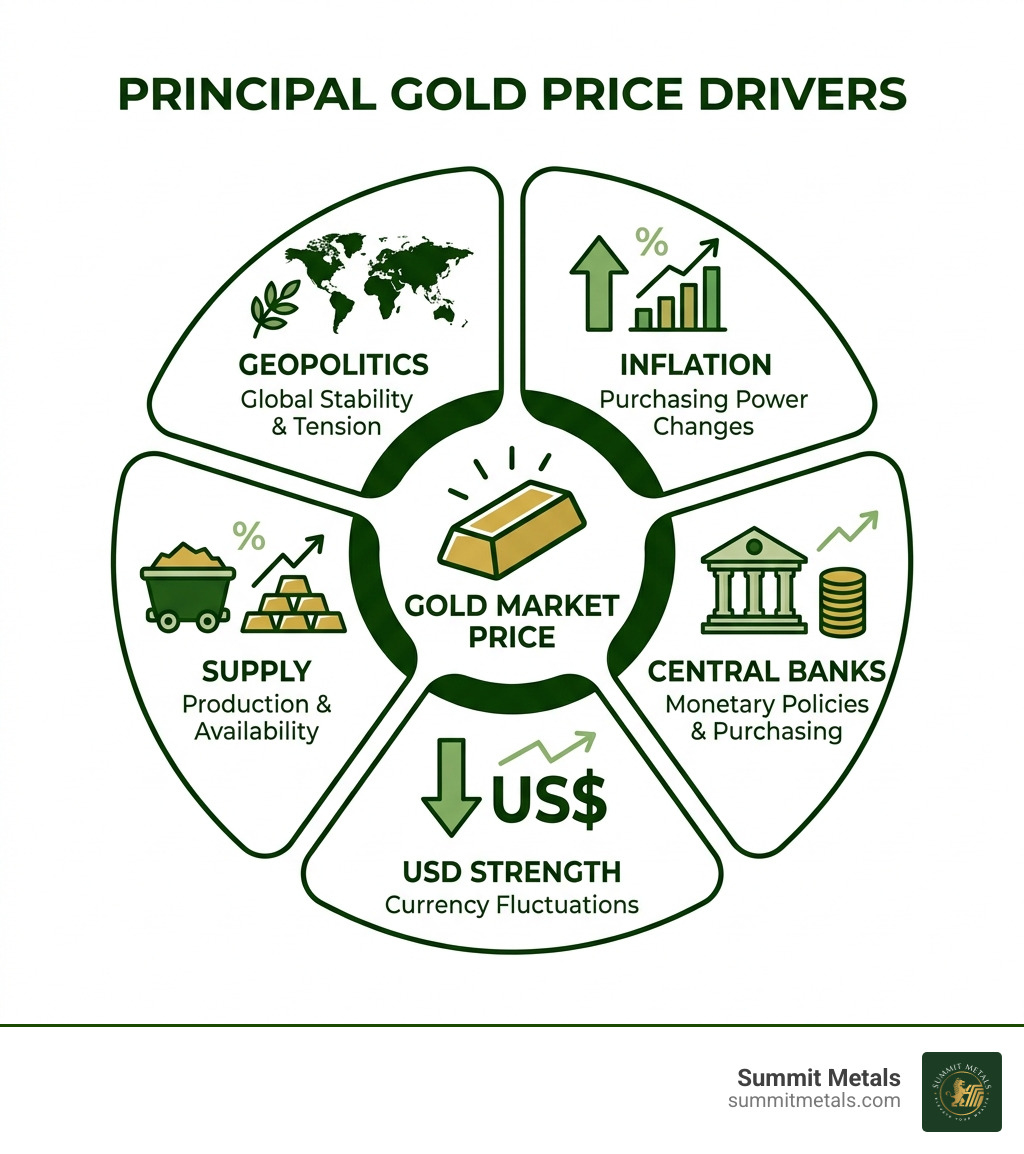
- The primary drivers right now: US-Iran tensions, Strait of Hormuz developments, inflation at 3.30%, and central bank buying
Gold prices shift by the second during market hours. The figures above are a snapshot — your actual buy or sell price will reflect the live market at the moment of your transaction.
This guide will walk you through everything you need to understand what is moving gold prices, how physical products are priced, and how to position yourself strategically — including through disciplined strategies like Autoinvest — in this market.
I'm Eric Roach, a former Wall Street investment banker and M&A advisor who has spent over a decade helping investors navigate today's gold market — from multi-billion-dollar institutional hedging programs to building resilient precious metals portfolios for everyday investors. I'll break down the data and give you the same disciplined, clear-eyed analysis that institutional traders rely on.
Analyzing Today's Gold Market: Live Prices and Trends
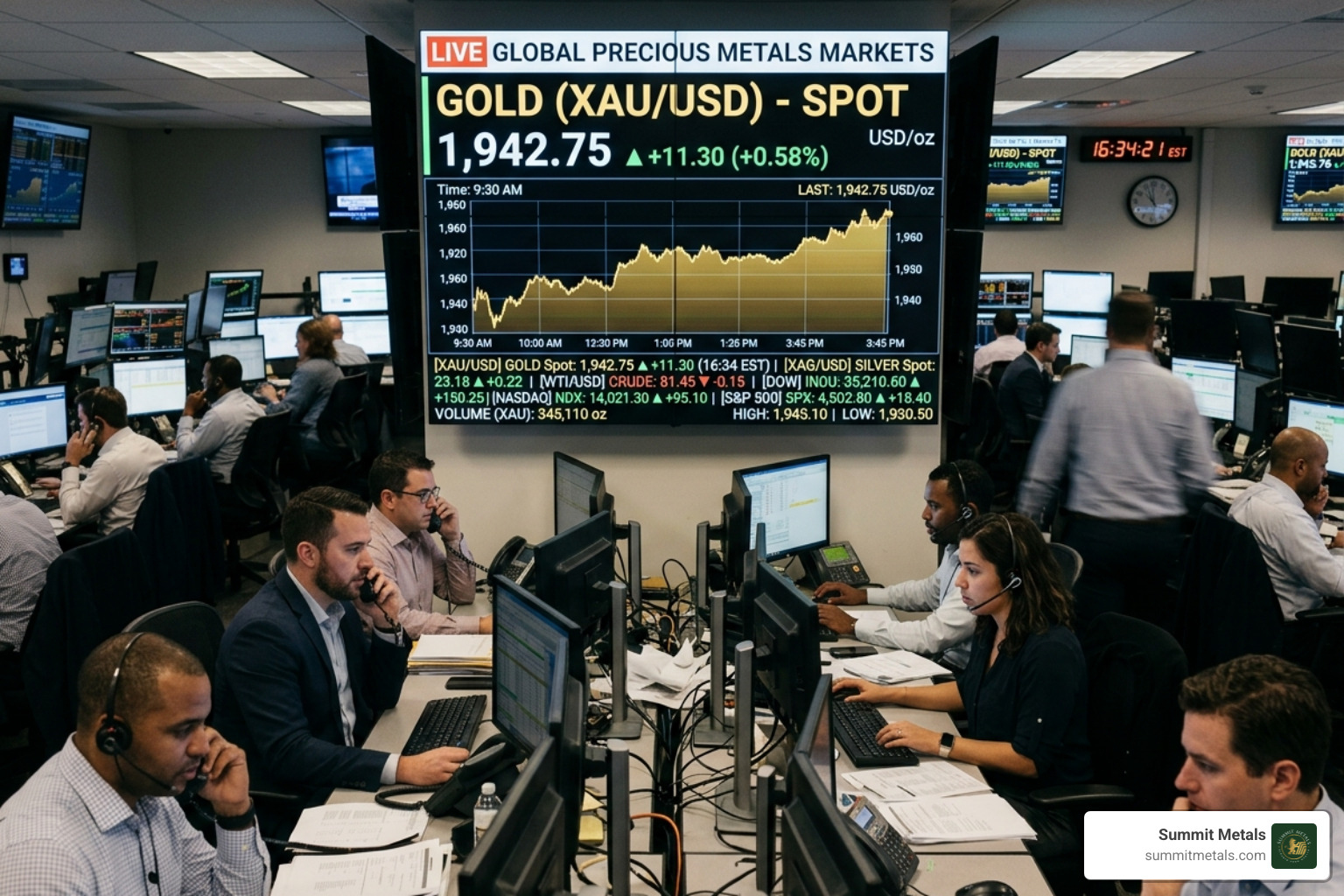
When we talk about the price of gold, we are usually referring to the "spot price." This is the theoretical benchmark for one troy ounce of .999 fine gold, delivered immediately. However, for those of us in Salt Lake City or across the U.S. looking to hold physical metal, the spot price is just the starting line.
To truly track live gold prices, you have to understand the mechanics behind the curtain. The market operates 24 hours a day, Sunday through Friday, moving from major hubs like London and Zurich to New York and Chicago. Most of the heavy lifting for price discovery happens on the COMEX, where futures contracts represent the collective "bet" of thousands of traders on where gold is headed next. If you want a broad market reference for live pricing, the London bullion market is one of the most widely recognized benchmarks in global precious metals trading.
It is also vital to distinguish between the "Bid" and the "Ask."
- Bid: What a dealer is willing to pay you for your gold.
- Ask: What the dealer is charging to sell that gold to you.
- Spread: The difference between the two, which covers the dealer's overhead and profit.
Understanding these basics is the first step in Spot Price vs Premium: How Precious Metals Pricing Works. At Summit Metals, we pride ourselves on transparency, ensuring our Salt Lake City neighbors see real-time data without the smoke and mirrors often found in high-pressure sales environments.
Current Spot Price Movements in Today's Gold Market
As we navigate April 2026, today's gold market is showing remarkable resilience. On April 17, 2026, the spot price hit $4,833.56 USD/t.oz, marking a nearly 1% climb in a single day. This isn't just a flash in the pan; gold has been on a tear, marking its fourth consecutive weekly increase.
Market analysis suggests that while we saw a staggering all-time high of $5,608.35 back in January, the current consolidation around the $4,800 level is actually a sign of market strength. We are seeing a "higher floor" being established. Even when the market dips - like the $21.00 intraday drop reported by some trackers - the buyers are stepping in quickly to support the price.
Market Discrepancies and Reporting
If you’ve ever checked three different websites and seen three different gold prices, you aren't alone. Reporting discrepancies between various global data providers and major retail platforms are common. One might report the "last trade" price, another the "London Fix," and another a weighted average of global exchanges.
For example, while a global data feed might show $4,833, a dealer's live "Ask" price might be closer to $4,794. These small gaps occur because the market moves faster than some websites can refresh. This is why we emphasize Gold Prices Today: Live Gold Price Chart & Historical Data as a tool for trend-watching rather than an exact quote for a specific coin. At Summit Metals, we use bulk purchasing power to smooth out these fluctuations, offering competitive rates that reflect the most accurate global data available.
Geopolitical and Economic Drivers in 2026

Gold is the ultimate "fear barometer." When the world gets messy, gold gets expensive. In 2026, the messiness is centered largely on the Strait of Hormuz and escalating US-Iran tensions.
The Strait of Hormuz is a narrow chokepoint through which a significant portion of the world's oil flows. Any threat to this passage—whether a naval blockade or a breakdown in ceasefire negotiations—sends shockwaves through the energy markets. Because oil and gold are often linked through inflation expectations, these geopolitical "flare-ups" act as a direct catalyst for gold's safe-haven demand. You can dive deeper into these dynamics in our guide on Key Factors Influencing Gold & Silver Prices: Supply, Demand, Geopolitics.
Inflation and Interest Rate Impacts
Economic data in April 2026 presents a complex puzzle. The US Inflation Rate is sitting at 3.30%, while the Fed Funds Rate is at 3.75%. Typically, gold struggles when interest rates are high because gold doesn't pay a dividend—you'd rather have your money in a high-yield savings account, right?
Not exactly. When inflation is persistent, the "real" interest rate (interest rate minus inflation) is actually quite low. In this environment, investors realize that their cash is losing purchasing power. As we discuss in Unlocking Today's Value: What Is the Current Price of Gold and Silver, gold acts as a hedge against this "hidden tax" of inflation.
Central Bank Activity and Oil Prices
One of the biggest "secret" drivers of today's gold market is the behavior of central banks. The People's Bank of China (PBoC) and other eastern central banks have been net buyers of gold for months, diversifying away from the US Dollar.
Interestingly, a recent drop in oil prices—caused by news that the Strait of Hormuz would remain open during a fragile ceasefire—actually helped gold. How? Lower oil prices eased immediate inflation fears, which led some analysts to believe the Fed might stop raising rates. This "hope for a pivot" gave gold the green light to rally toward the $4,900 resistance level.
Physical Gold Products: Maximizing Value and Security
If you’ve decided to move into physical gold, you face a classic choice: Coins or Bars? While both contain the same chemical element (Au), they serve different strategic purposes.
Coins like the American Eagle or Canadian Maple Leaf carry a "legal tender" status. This means they are backed by a sovereign government, providing an extra layer of authenticity and fraud protection. Bars, on the other hand, are often the choice for those looking to acquire the most "metal for their money," as they typically carry lower mintage premiums. We break down the cost per gram in our resource Gold Price Today in USA Per Gram.
Comparing Gold Coins and Bars
To help you decide, we've put together a simple comparison. There is no "wrong" choice, only the choice that fits your specific goals.
| Feature | Gold Coins (e.g., American Eagle) | Gold Bullion Bars |
|---|---|---|
| Premium | Higher (due to mintage/design) | Lower (bulk manufacturing) |
| Legal Tender | Yes (Face value protected) | No |
| Fraud Protection | High (Harder to counterfeit) | Moderate (Requires assay) |
| Liquidity | Extremely High (Recognized globally) | High (Standardized weights) |
| Best For | New investors, collectors, portability | Large-scale wealth preservation |
One major benefit of owning a gold coin is the face value. While an American Eagle is worth its weight in gold (currently ~$4,800), it technically has a face value (e.g., $50). While you'd never spend it at the grocery store for $50, that legal tender status makes it a federal crime to counterfeit, offering a level of security that generic bars don't always share.
Understanding the Gold/Silver Ratio
Smart investors in today's gold market always keep one eye on silver. Currently, with silver priced at $79.28, the gold/silver ratio is a key indicator of value. Historically, when this ratio gets too high, it suggests that silver is undervalued compared to gold.
With the silver market projected to face another deficit in 2026 due to industrial demand, many of our Salt Lake City clients are using gold's strength to diversify into silver. For more on this, check out Unlocking Value: Understanding Gold and Silver's Current Worth.
Strategic Investing: Autoinvest and Exit Planning
The biggest mistake most investors make is trying to "time" the market perfectly. They wait for a dip that never comes, or they buy at the peak out of FOMO (Fear Of Missing Out).
At Summit Metals, we recommend a more disciplined approach: Autoinvest. This allows you to "Dollar Cost Average" (DCA) into your gold position. By shopping with us every month—just like you would contribute to a 401k—you buy more gold when prices are low and less when prices are high. Over time, this smooths out the volatility of today's gold market and builds a significant nest egg without the stress of daily price watching. Learn more at our Autopays services page.
Exit Strategies and Liquidity
Investing is only half the battle; you also need an exit strategy. We don't just want to help you buy; we want to ensure you can sell when the time is right.
We offer Private Vault Storage, which keeps your metals secure and, more importantly, "liquid." If your gold is stored in a secure, audited facility, you can sell it back to us instantly without the hassle of shipping or re-assaying the metal. When you are ready, you can Sell to us for competitive rates, ensuring your investment remains a true liquid asset.
Historical Performance and Future Price Projections
To understand where we are going, we have to look at where we've been. Gold has an average annualized return of about 7.78% to 8.0% over the last few decades. But the recent performance has been explosive.
In January 2026, gold reached a staggering all-time high of $5,608.35. While the price has retraced since then, it is still up over 40% compared to this time last year. This long-term upward trajectory is what we call "The Daily Shine," a concept we explore in The Daily Shine: Unpacking Today's Gold Price in the USA.
Short-Term Forecasts for Today's Gold Market
What do the next 12 months look like? Most analysts remain bullish.
- End of Quarter Target: $4,919.42
- 12-Month Expectation: $5,271.00
These forecasts are driven by the expectation that geopolitical uncertainty will remain high while interest rate pressures might eventually ease. As we note in Live Metal Prices: Your Daily Dose of Market Insights, even a "peace plan" in the Middle East might only provide a temporary dip before the long-term reality of currency devaluation sets back in.
Frequently Asked Questions about Today's Gold Market
Why is the spot price different from the price of a gold coin?
The spot price is for "unfabricated" gold. To turn that raw gold into a beautiful American Eagle, a mint has to refine the metal, strike the coin, and distribute it. Dealers also have costs for shipping, insurance, and storage. This "premium" is what you pay for the convenience, security, and legal tender status of a physical product.
Is April 2026 a good time to invest in gold?
While gold is trading near historical highs, many investors see this as a "breakout" phase. With inflation at 3.30% and massive central bank buying, the fundamental reasons to own gold—diversification and wealth preservation—are stronger than ever. Using an Autoinvest strategy can help mitigate the risk of buying at a temporary peak.
How do geopolitical events in the Middle East affect my investment?
Events like the tensions in the Strait of Hormuz create "risk-off" sentiment. When investors are scared, they sell stocks and buy gold. Even if tensions ease, the massive amount of debt and currency printing used to fund global conflicts usually leads to long-term inflation, which is historically positive for gold prices.
Conclusion
Navigating today's gold market requires a blend of real-time data and long-term perspective. Whether you are tracking the latest $4,833 spot price or looking toward the $5,271 yearly forecast, the goal remains the same: protecting your hard-earned wealth from the erosive forces of inflation and uncertainty.
At Summit Metals, we are proud to serve our community from our base in Wyoming and our locations in Salt Lake City, Utah. We offer authenticated gold and silver with transparent, real-time pricing. Because we purchase in bulk, we can pass those competitive rates directly to you, ensuring you get the most value for every dollar invested.
Ready to take the next step? Whether you're starting a monthly Autoinvest plan or making a one-time purchase to secure your future, we're here to help. Start your gold investment journey today and see why physical gold remains the ultimate standard of value.


