

The 1852 Double Eagle Gold Coin: A Rare Piece of American History Worth Knowing About
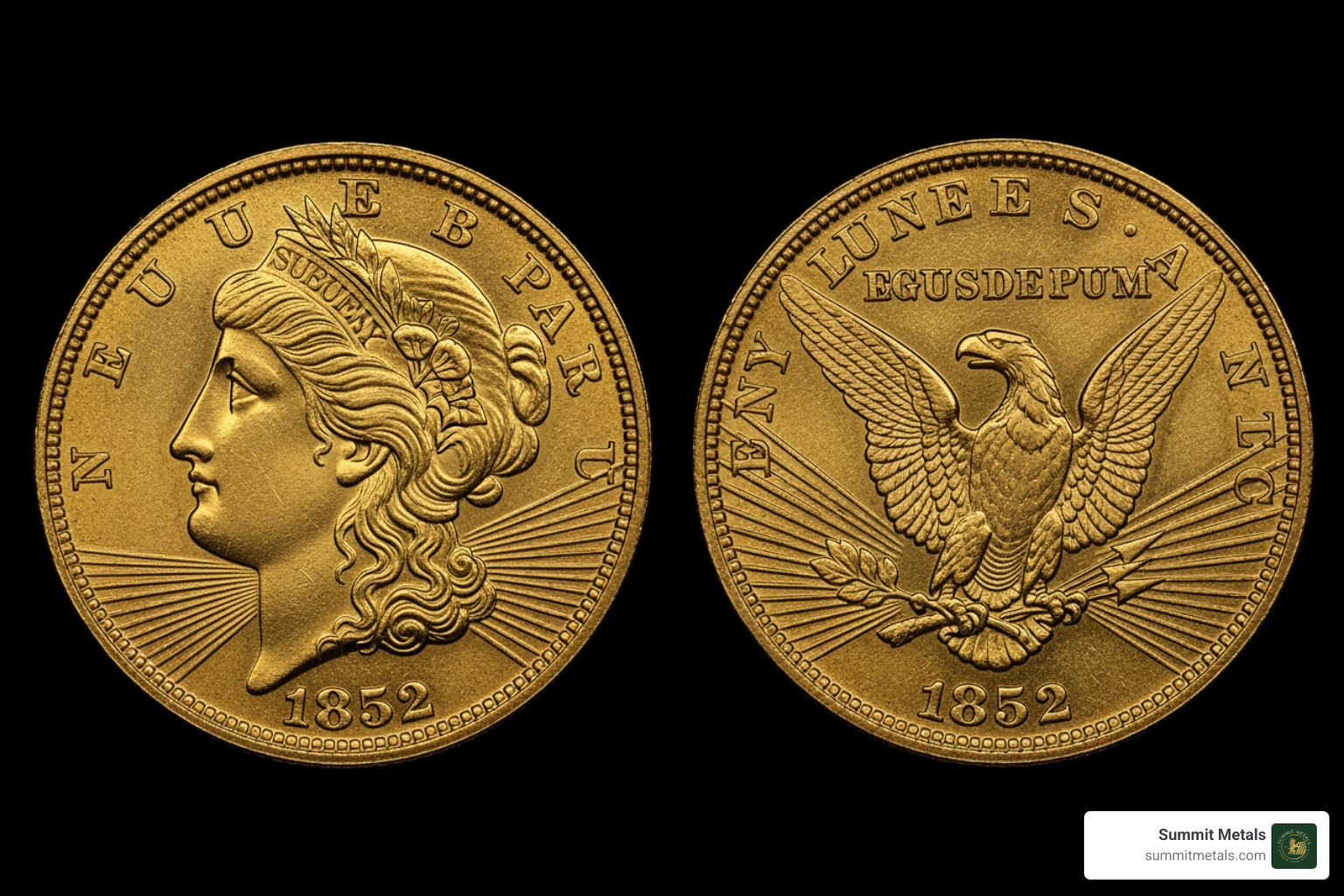
The 1852 double eagle gold coin is one of the most historically significant U.S. gold coins ever struck — a $20 Liberty Head piece born directly from the California Gold Rush, and today a genuine rarity in top condition.
Here's what you need to know at a glance:
| Feature | 1852 Philadelphia | 1852-O New Orleans |
|---|---|---|
| Mintage | 2,053,026 | 190,000 |
| Gold Content | 0.9675 Troy oz | 0.9675 Troy oz |
| Melt Value (at time of publication) | ~$3,132 | ~$3,132 |
| Circulated Value (VF) | ~$2,450 | ~$3,750 |
| MS-63 Value | ~$30,000 | ~$150,000 |
| Auction Record | $288,000 (PCGS MS65 CAC) | — |
| Known Mint State Examples | ~100–150+ | Only 9 graded MS-60 (NGC) |
Despite its large original mintage, the 1852 Philadelphia double eagle is exceptionally rare in Mint State. Most coins circulated heavily — $20 was roughly five weeks' wages in the 1850s. Few people saved them, and even fewer numismatists were around to preserve them.
That gap between "millions minted" and "almost none survive uncirculated" is exactly what makes this coin so compelling for collectors and investors alike.
I'm Eric Roach, a former Wall Street investment banker and M&A advisor who now helps everyday investors build wealth through precious metals — including rare numismatic pieces like the 1852 double eagle gold coin. Read on for a complete breakdown of its history, value, and how to acquire one strategically.
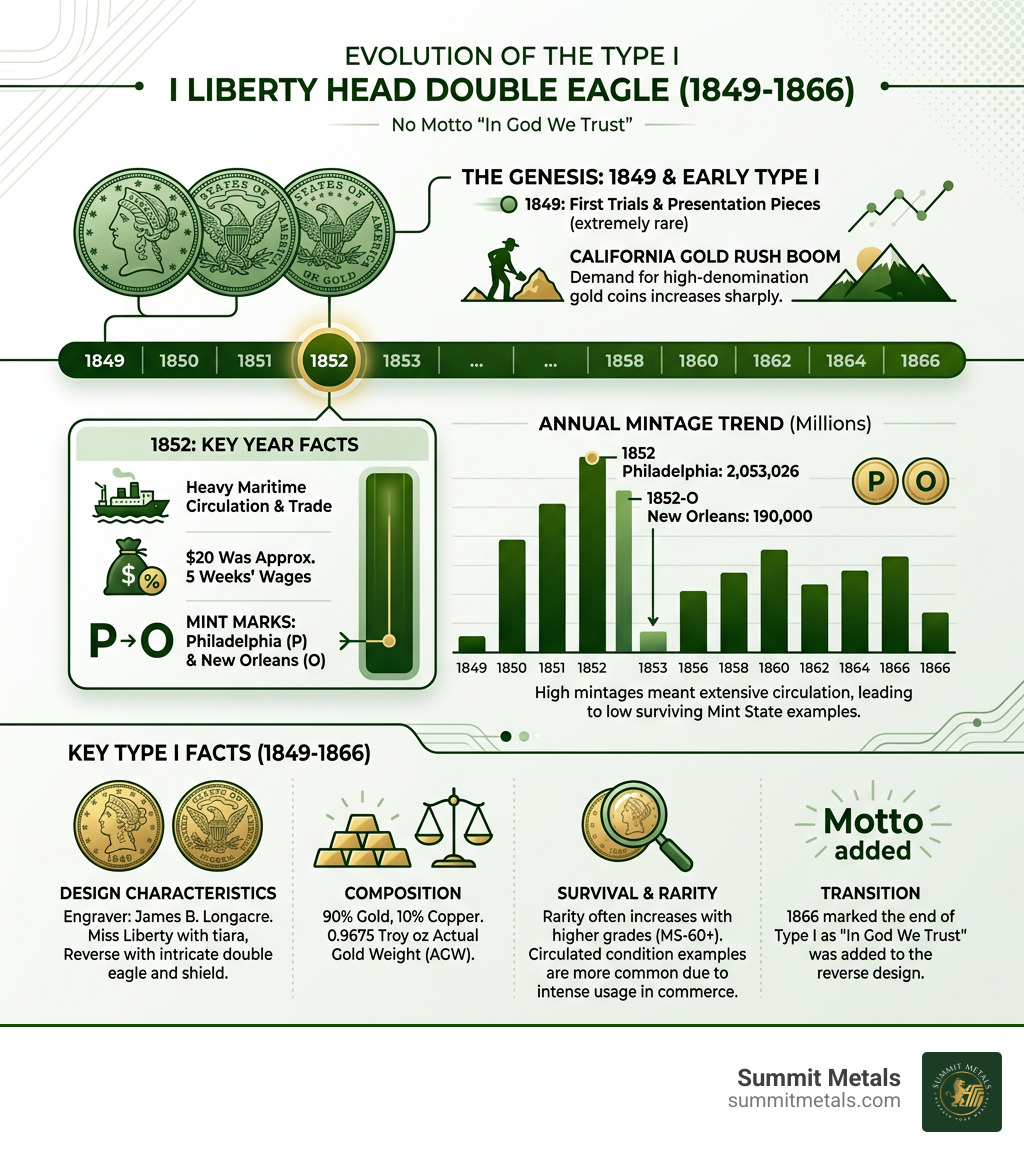
1852 double eagle gold coin word guide:
Historical Significance and the Type I Liberty Head Design
To understand the 1852 double eagle gold coin, we have to go back to January 24, 1848. When James Marshall discovered gold at Sutter’s Mill, he didn't just start a rush; he fundamentally changed the American economy. Suddenly, the U.S. Treasury was flooded with more gold than it knew what to do with. At the time, the largest gold coin was the $10 Eagle. With so much bullion pouring in, the government needed a larger denomination for international commerce and banking.
Enter James B. Longacre, the fourth Chief Engraver of the U.S. Mint. He was tasked with designing the "Double Eagle," worth $20. For the obverse, Longacre looked to classical antiquity, drawing inspiration from the "Crouching Venus" statue for his profile of Lady Liberty. On the reverse, he designed a majestic Heraldic Eagle with a shield, olive branches, and arrows, surrounded by the words "UNITED STATES OF AMERICA" and the denomination "TWENTY D."
By 1852, the production of these coins was in full swing. This era (1849–1866) is known as the "Type I" or "No Motto" period because the coins did not yet feature the phrase "In God We Trust." During this time, the 1852 double eagle gold coin was the workhorse of the American financial system. Because of a general distrust of paper money, these heavy gold pieces were the preferred method for conducting large-value international transactions. You can learn more about this fascinating period in our guide to Discovering the Legacy of Liberty Head Gold Coins.
Technical Specifications and Investment Comparison
When we talk about the 1852 double eagle gold coin, we are talking about a serious piece of precious metal. Each coin contains nearly a full ounce of pure gold. Specifically, it has a gold content of 0.9675 Troy oz, with a total weight of 33.4 grams and a diameter of 34mm. The composition is 90% gold and 10% copper, an alloy designed to make the coin durable enough for circulation.
For many investors in Salt Lake City and beyond, the question often arises: should I buy rare coins or modern gold bars? While bars are excellent for tracking the spot price of gold, numismatic coins offer a layer of protection and potential upside that bars cannot match.
Comparison: Gold Coins vs. Gold Bars
| Feature | Rare Gold Coins (e.g., 1852 Double Eagle) | Modern Gold Bars |
|---|---|---|
| Intrinsic Value | High (Gold Content) | High (Gold Content) |
| Numismatic Premium | Yes (Rarity & History) | No |
| Fraud Resistance | High (Certified/Graded) | Moderate |
| Legal Tender Status | Yes (Face Value Protection) | No |
| Market Volatility | Low (Historical demand buffers spot drops) | High (Tied directly to spot) |
| Collectibility | Extremely High | Low |
Owning a coin like the 1852 Double Eagle provides "Face Value Protection." While a bar is just a hunk of metal, these coins are recognized legal tender. Furthermore, because they are historical artifacts, their value is not solely tied to the daily fluctuations of the gold market. If you are debating between the two, check out our deep dive into Bars or Coins: Your Ultimate Gold Investment Showdown. It is also vital to understand the "fineness" of your holdings; we cover that in our guide on Understanding Karats and Purity in Gold.
Philadelphia vs. New Orleans: Mintage and Rarity
In 1852, two mints produced the $20 gold piece: Philadelphia (which used no mint mark) and New Orleans (which used the "O" mint mark).
The Philadelphia Mint produced a massive 2,053,026 coins. On paper, that sounds like a lot. However, the survival rate for these coins in high grades is shockingly low. Most went straight into bags, were shipped across the Atlantic, or were worn down in daily trade. Expert resources like the 1852 — Double Eagle Book and the 1852 $20 MS | Coin Explorer note that while thousands exist in circulated grades, true Mint State examples are few and far between.
The New Orleans mintage (1852-O) is a different beast entirely. Only 190,000 were struck. The New Orleans Mint was notorious for producing coins with "soft" strikes, and because they were minted in the South, many were lost or melted during the Civil War. Today, an 1852-O in any uncirculated grade is a world-class rarity.
Shipwrecks and Hoards
A significant portion of the high-grade Type I Double Eagles known today didn't come from bank vaults — they came from the bottom of the ocean. Shipwrecks like the SS Central America (the "Ship of Gold") and the SS Republic have yielded spectacular specimens that were preserved in the cold, anaerobic environment of the deep sea. Other notable finds include the Baltimore Hoard (discovered by two boys in a cellar in 1934) and the Fairmont Hoard, which recently brought over 100 examples of the 1852 date to the market.
The Market Value of the 1852 Double Eagle Gold Coin
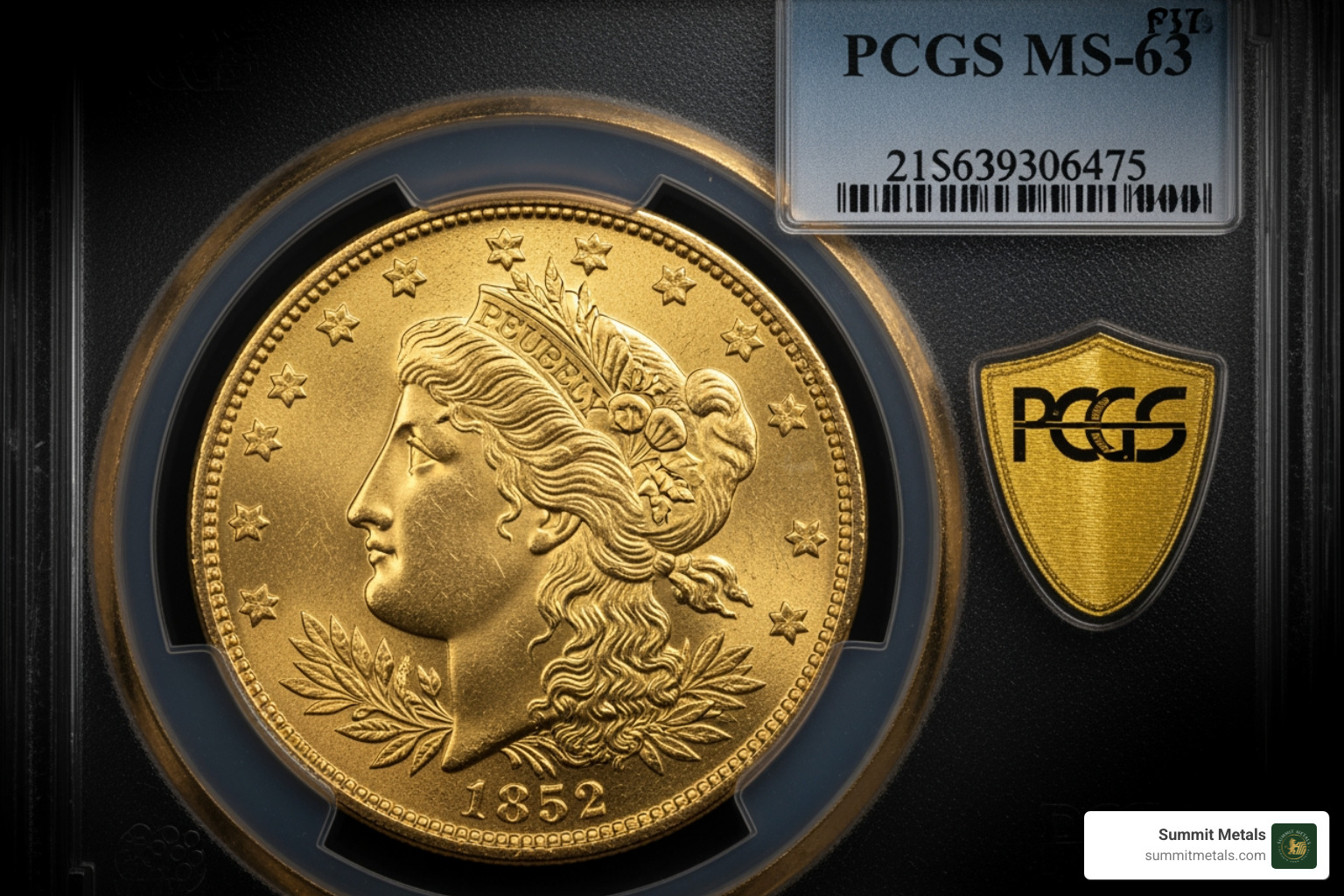
Pricing for the 1852 double eagle gold coin is determined by the Sheldon Grading Scale (1–70). Because these coins are nearly 175 years old, even a small difference in grade can mean a difference of tens of thousands of dollars.
- Circulated (VF to EF): These coins typically trade for a modest premium over their gold melt value. They are great for "stackers" who want historical gold without the "collector" price tag.
- About Uncirculated (AU-55 to AU-58): These show slight wear on Liberty's hair and the eagle's wingtips. They are becoming increasingly scarce as more collectors enter the market.
- Mint State (MS-60 to MS-63): This is where the 1852 becomes a "condition rarity." An MS-63 Philadelphia example can command around $30,000.
- The Rare Gems (MS-64+): The auction record stands at $288,000 for a PCGS MS65 CAC example sold in 2022.
When evaluating these coins, we look at "eye appeal." Does the coin have a frosty luster, or is it satiny? Are there heavy "bagmarks" (scratches from coins clinking together in bags)? To see if your coin might be a "key date" treasure, read our article: Is Your Liberty Head Gold Coin a Hidden Fortune? A Deep Dive into Key Dates.
Identifying the 1852 Double Eagle Gold Coin Varieties
Collectors love "varieties" — coins with slight errors or differences in the die. For the 1852, the most famous is the Doubled Date. About 5-10% of the mintage shows clear doubling on the numbers of the year. While common in lower grades, a Doubled Date in AU-55 or higher is a prized find that can command a 10-15% premium. You should also watch out for "repunched dates" and coins from late die states, which might show weakness around the obverse borders.
Why the 1852 Double Eagle Gold Coin is a Condition Rarity
It seems counterintuitive that a coin with a mintage of 2 million could be rare. But remember: in 1852, there were very few coin collectors. A $20 gold piece was a massive amount of money — equivalent to roughly $750 today in purchasing power, but much harder to earn. People didn't tuck these away in drawers; they spent them. This makes the survival of any 1852 double eagle gold coin in Mint State a statistical miracle. This concept of "condition rarity" is similar to what we see with other early gold, such as the 1836 Quarter Eagle, which we discuss in Unlocking the Secrets of the 1836 Quarter Eagle for Collectors.
Strategic Acquisition and Exit Strategies with Summit Metals
At Summit Metals, we believe that gold investment shouldn't be a guessing game. Whether you are looking for a circulated 1852 double eagle gold coin or a modern bullion piece, we provide the transparency and competitive rates you need to invest with confidence.
Autoinvest: The Smart Way to Accumulate Gold
One of the best ways to build a gold position is through our Autoinvest program. Much like a 401(k), you can set up a recurring monthly purchase. This allows you to "dollar cost average," buying more gold when prices are lower and less when they are higher. It takes the emotion out of investing and ensures you are consistently building your "private gold standard."
Storage and Your Exit Strategy
Buying gold is only half the battle; you also need a plan for where to keep it and how to sell it. We recommend using private vault storage or IRS-approved depositories for maximum security. You can learn about your options in our guide: Stashing Your Shine: A Guide to IRS-Approved Precious Metals Depositories.
When it comes time to liquidate, our "Sell to Us" program ensures you have a guaranteed exit strategy. We don't just sell you the metal; we are here to buy it back at fair, real-time prices when you are ready to realize your gains. For tips on getting the best price, see Where Can I Sell My Gold Coins for Best Price?.
Frequently Asked Questions about the 1852 Double Eagle
What is the gold content of an 1852 Double Eagle?
Each 1852 double eagle gold coin contains 0.9675 Troy oz of pure gold. It is minted in a 90% gold and 10% copper alloy for durability.
How many 1852-O Double Eagles still exist?
While 190,000 were minted in New Orleans, only a few thousand are estimated to survive in all grades. In Mint State, they are incredibly rare; NGC has graded only 9 examples as MS-60.
Why is the 1852 Double Eagle more valuable than its melt price?
Its value comes from its "numismatic premium." This includes its historical significance as a relic of the Gold Rush, its rarity in high grades (condition rarity), and the demand from collectors who want to complete a Type I Liberty Head set.
Conclusion
The 1852 double eagle gold coin is more than just a piece of bullion; it is a numismatic treasure that captures the spirit of the American frontier. From the docks of New Orleans to the bustling banks of Philadelphia, these coins fueled the growth of a nation. For the modern investor, they offer a unique combination of intrinsic gold value and historical rarity.
Whether you are a seasoned collector or a first-time investor in Salt Lake City, Summit Metals is here to help you navigate precious metals. From our Autoinvest program to our transparent "Sell to Us" exit strategy, we provide the tools you need for long-term success. To learn more about other iconic U.S. gold coins, check out our guide on Everything you need to know about American Eagle coins.


