

A Coin Forged in Gold Rush Fever
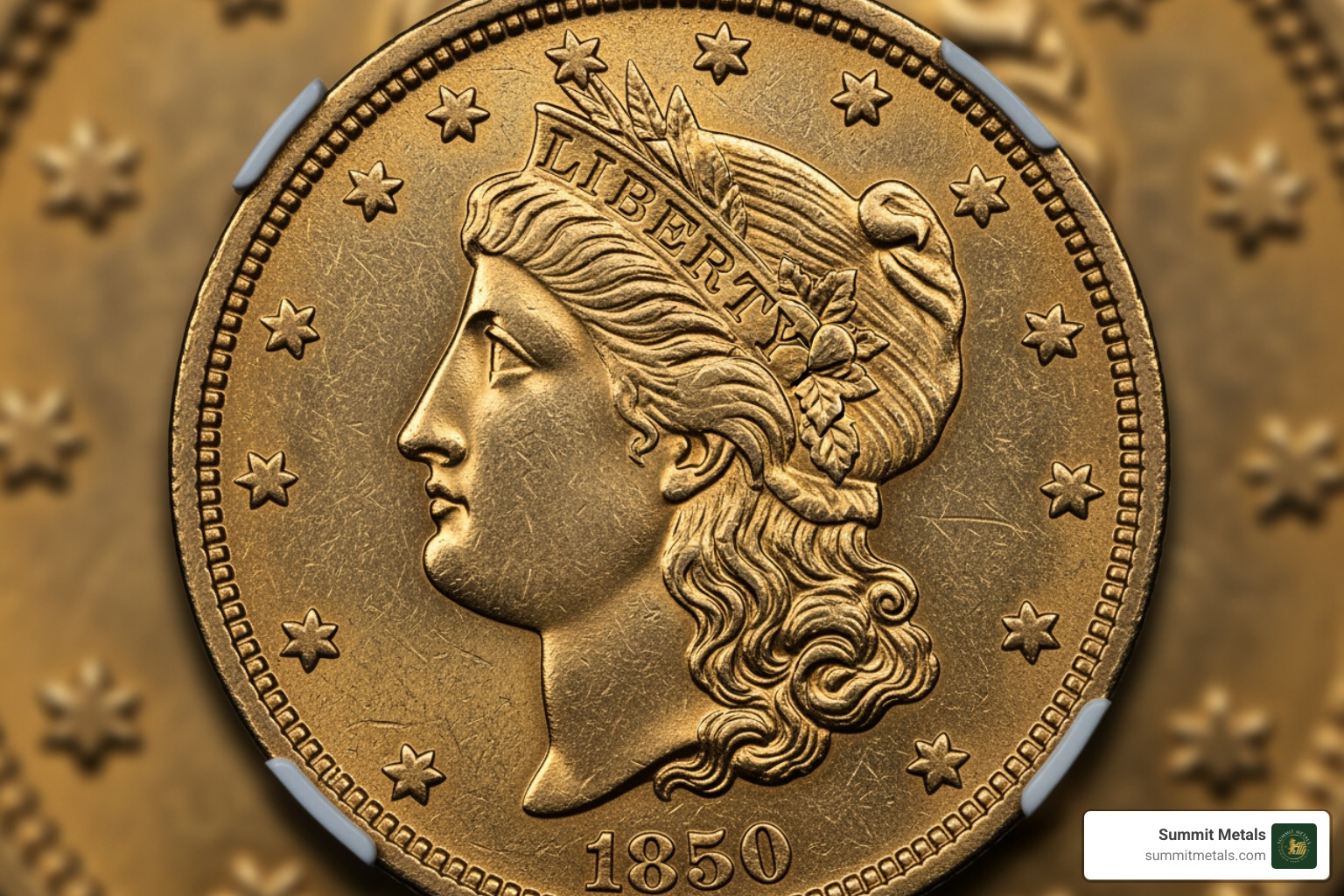
The 1850 $20 liberty gold double eagle is the first widely available year of the largest gold coin the United States Mint ever produced for regular circulation. Born from the California Gold Rush and authorized by Congress in 1849, this coin marks a pivotal moment in American monetary history—when vast quantities of newly finded gold demanded a denomination that could efficiently store and transport wealth.
Quick Facts: The 1850 $20 Liberty Gold Double Eagle
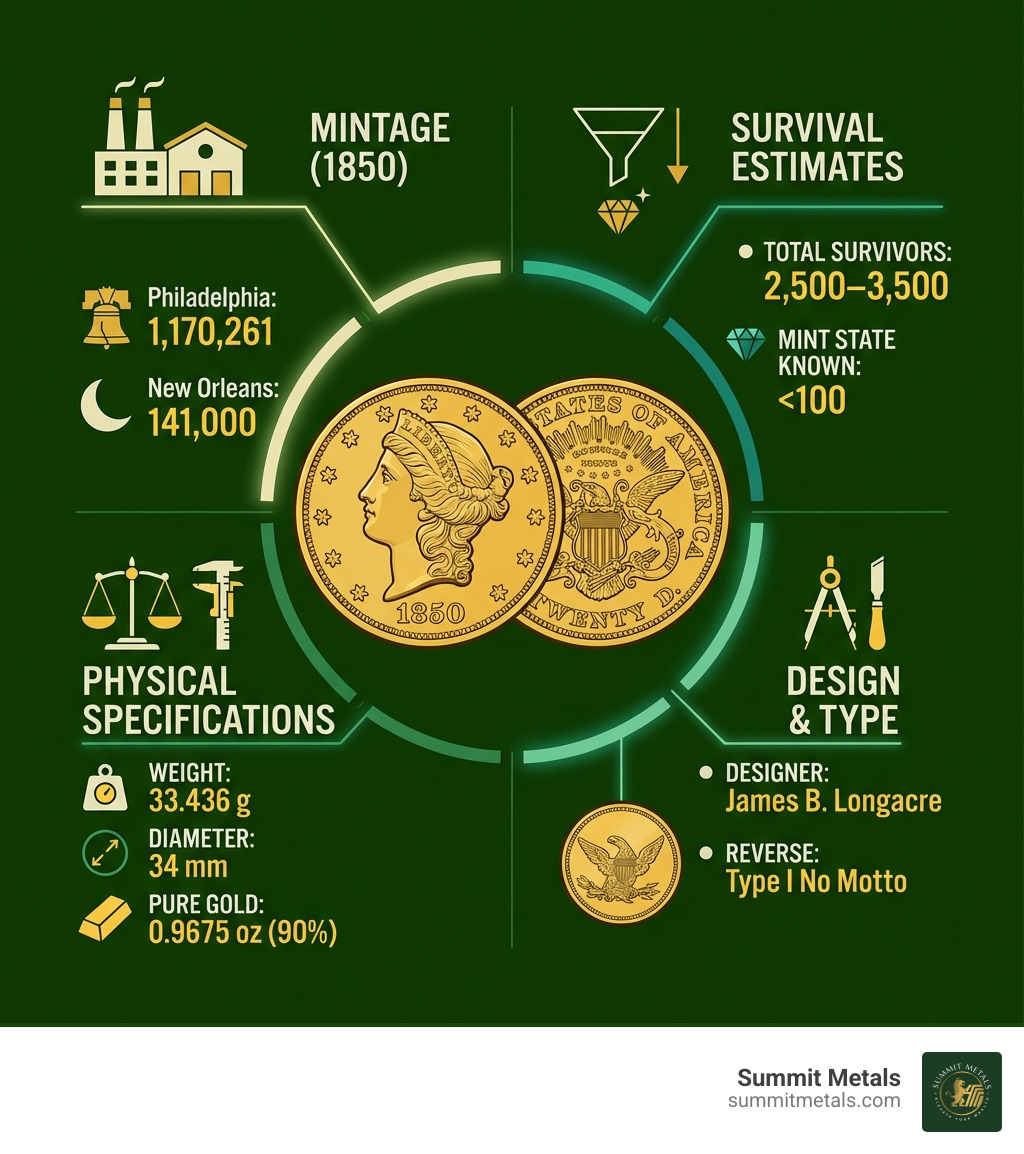
- Mintage: 1,170,261 pieces (Philadelphia Mint) + 141,000 (New Orleans Mint)
- Gold Content: 0.9675 troy ounces of pure gold (90% purity)
- Designer: James B. Longacre, Chief Engraver of the U.S. Mint
- Survival Estimate: 2,500–3,500+ total; fewer than 100 in Mint State
- Current Value: $3,000–$8,000 for circulated examples; $10,000+ for uncirculated grades (prices shown are at the time of this publication)
- First-Year Appeal: Highly sought by collectors as the first regular-issue $20 gold coin
This coin offers both numismatic significance and investment appeal. Collectors prize it as a first-year issue with strong historical ties to westward expansion. Investors value its substantial gold content and enduring demand. Unlike modern bullion, each Double Eagle carries a government-guaranteed face value and a story that reaches back to America's most legendary gold rush.
Why the 1850 stands out
While later years are easier to find, the 1850 Double Eagle commands attention because it represents the origin of a series that would run for nearly six decades. Mint State examples are genuinely rare—fewer than a dozen Choice pieces are known—and even well-circulated coins remain in demand due to their historical importance.
I'm Eric Roach, and over the past decade I've guided hundreds of clients through precious-metals strategy, including how historic gold coins like the 1850 $20 liberty gold double eagle can serve as both a hedge against inflation and a tangible link to American heritage. My Wall Street background in risk management helps investors balance modern portfolios with alternative assets that have stood the test of time.
From California Hills to Global Commerce: The Birth of the Double Eagle
The year 1848 wasn't just about gold; it was about destiny. The findy of vast quantities of gold in California created an unprecedented supply of the precious metal, overwhelming the existing coinage system. The highest denomination at the time, the $10 gold eagle, simply wasn't sufficient to handle the massive transactions that followed. Imagine trying to pay for a modern-day luxury car with only $10 bills – that's the kind of logistical challenge the U.S. Treasury faced.
In response, Congress authorized the $20 gold coin, known as the "Double Eagle," with the Act of March 3, 1849. This new denomination was twice the size of the previous highest, designed to facilitate the conversion of gold bullion into a convenient coinage form and streamline international trade of large value. It was a practical solution to a golden problem, and it quickly became a cornerstone of American finance.
The 1850 $20 liberty gold double eagle was the first year this new denomination entered regular circulation, primarily from the Philadelphia Mint, which produced a staggering 1,170,261 pieces. A smaller, but still significant, number (141,000) were also struck at the New Orleans Mint. This coin's debut was a direct result of the California Gold Rush, making it a tangible link to one of the most transformative periods in American history. Over 75% of gold used for U.S. coinage up to 1933 was made into double eagles, underscoring their immense economic impact.
For those interested in a deeper dive into the history of this remarkable series, resources like the Liberty Head double eagle overview and the PCGS CoinFacts history of the 1850 Double Eagle provide extensive background on how this coin shaped U.S. and global commerce.
The Vision of James B. Longacre
The task of creating this magnificent coin fell to James B. Longacre, the Chief Engraver of the U.S. Mint. Longacre was a prolific artist, and his "Liberty Head" design, also known as the Coronet Head, was an enlarged and adapted version of his earlier work for the gold dollar and half eagle. His vision brought a touch of classical elegance to American coinage.
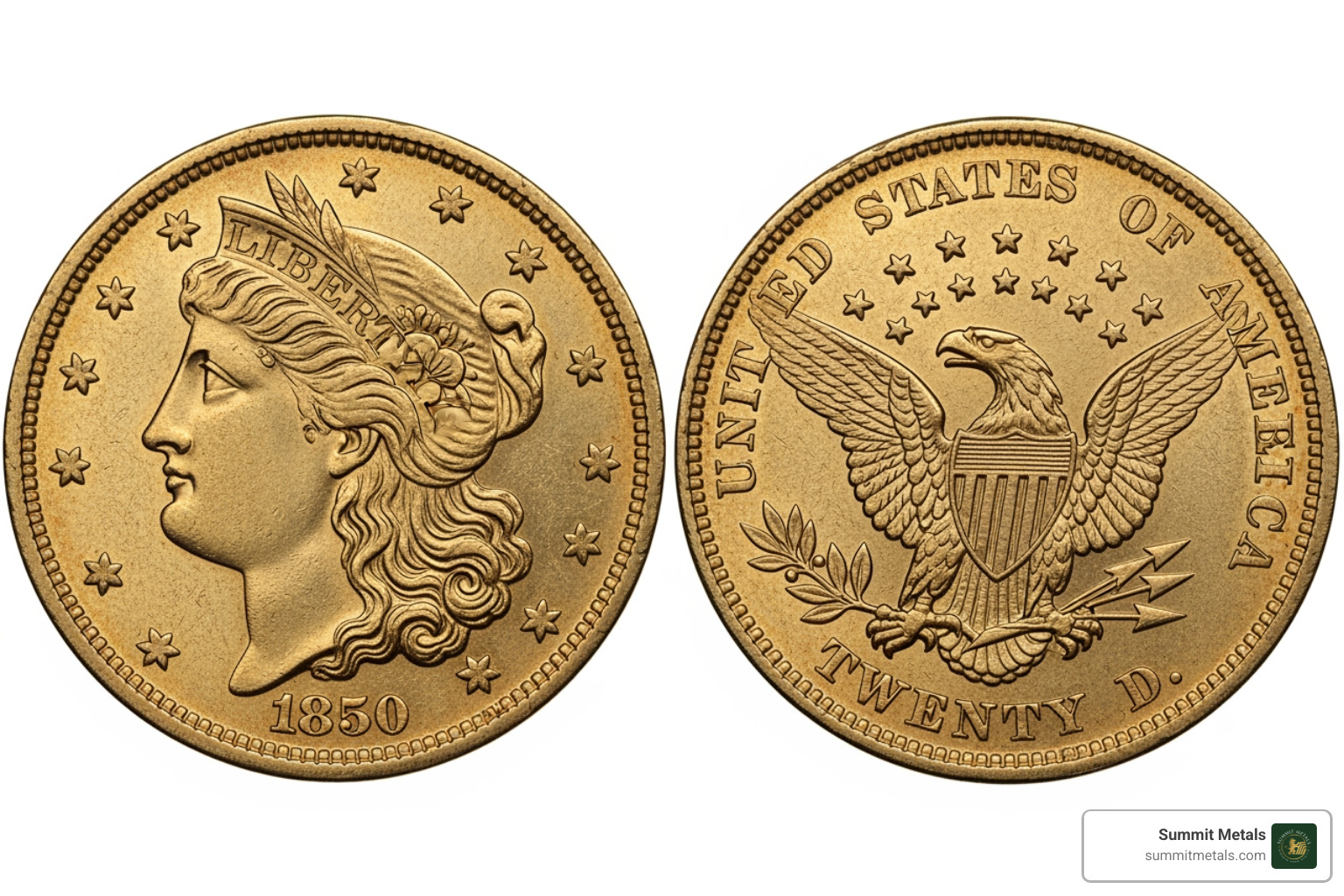
The obverse of the coin features a Greco-Roman inspired bust of Lady Liberty, facing left, her hair tied back and adorned with a coronet inscribed with "LIBERTY." Surrounding her are 13 stars, representing the original states, and the year of mintage, 1850, at the bottom.
The reverse showcases a majestic heraldic eagle with outstretched wings, clutching an olive branch (symbolizing peace) and arrows (representing strength) in its talons. A shield emblazoned with the U.S. national emblem covers its chest. Above the eagle, a glory of rays and stars adds to its grandeur. The inscription "UNITED STATES OF AMERICA" arcs above, and the denomination "TWENTY D." appears below. This initial design, minted from 1850-1866, is known as the Type I "No Motto" design because it does not yet include "IN GOD WE TRUST," which would be added later due to the Civil War.
Key Design Elements of the 1850 $20 Liberty Gold Double Eagle
Understanding the intricate details of the 1850 $20 liberty gold double eagle is part of its charm. Let's break down its key features:
-
Obverse (Front):
- Lady Liberty: A classical bust of Liberty faces left, her hair gracefully pulled back.
- Coronet: A diadem, or coronet, rests on her head, prominently inscribed with the word "LIBERTY."
- Stars: Thirteen stars encircle the bust, representing the original thirteen colonies.
- Date: The year "1850" is boldly displayed at the bottom.
-
Reverse (Back):
- Heraldic Eagle: A powerful bald eagle is centrally featured, wings spread wide.
- Shield: An ornate shield with vertical stripes and a horizontal bar covers the eagle's chest.
- Olive Branch & Arrows: The eagle grasps an olive branch in its right talon and a bundle of arrows in its left, symbolizing peace and preparedness.
- Glory: Above the eagle's head, an arc of rays and stars (a "glory") radiates outwards.
- Inscriptions: "UNITED STATES OF AMERICA" is inscribed along the top rim, and the denomination "TWENTY D." is at the bottom.
- Absence of Motto: Notably, the Type I design (1850-1866) does not include the motto "IN GOD WE TRUST," which was added to U.S. coinage starting in 1866.
These elements combine to create a coin that is not only valuable for its gold content but also for its artistic merit and historical narrative.
Decoding the Value: Rarity and Grading of the 1850 $20 Liberty Gold Double Eagle
When we talk about the value of the 1850 $20 liberty gold double eagle, we're looking at a fascinating interplay of mintage figures, survival rates, and condition. While the Philadelphia Mint struck a hefty 1,170,261 pieces in 1850, and New Orleans added another 141,000, these numbers don't tell the whole story. Decades of heavy circulation, melting, and the infamous Executive Order 6102 of 1933 (which required most gold coins to be surrendered to the government) drastically reduced the number of survivors.
Our estimated survival rate for the 1850 Philadelphia issue is around 3,370 pieces, and for the 1850-O, perhaps 630 known examples. This makes the 1850-O significantly scarcer. Most of these survivors are found in circulated conditions. In fact, fewer than 100 of the 1850 Double Eagles exist in uncirculated condition across both mints, making Mint State examples truly rare and highly coveted.
Are there any known proof specimens? Yes, this is where it gets even more exciting! It's believed that possibly two or three proof specimens were struck in 1850. One confirmed example resides in the Bibliothèque Nationale de France in Paris, a testament to its international appeal even then. Imagine the thrill of finding one of the others!
Shipwreck findies have also played a role in the availability of these coins. Significant hoards like the S.S. Republic (53 coins), the S.S. Central America (26 coins), and the "Baltimore Hoard" (92 coins) have brought some examples back to the market, often in varying states of preservation. These finds offer tantalizing glimpses into the past and can sometimes introduce coins with unique characteristics due to their underwater journeys.
For a comprehensive look at specific mintage details, die varieties, and grading populations, the PCGS CoinFacts page for the 1850 $20 Liberty Gold Double Eagle is an invaluable external reference that pairs well with Summit Metals' real-time pricing when you're evaluating a potential purchase or sale.
Understanding Grades and Conditions
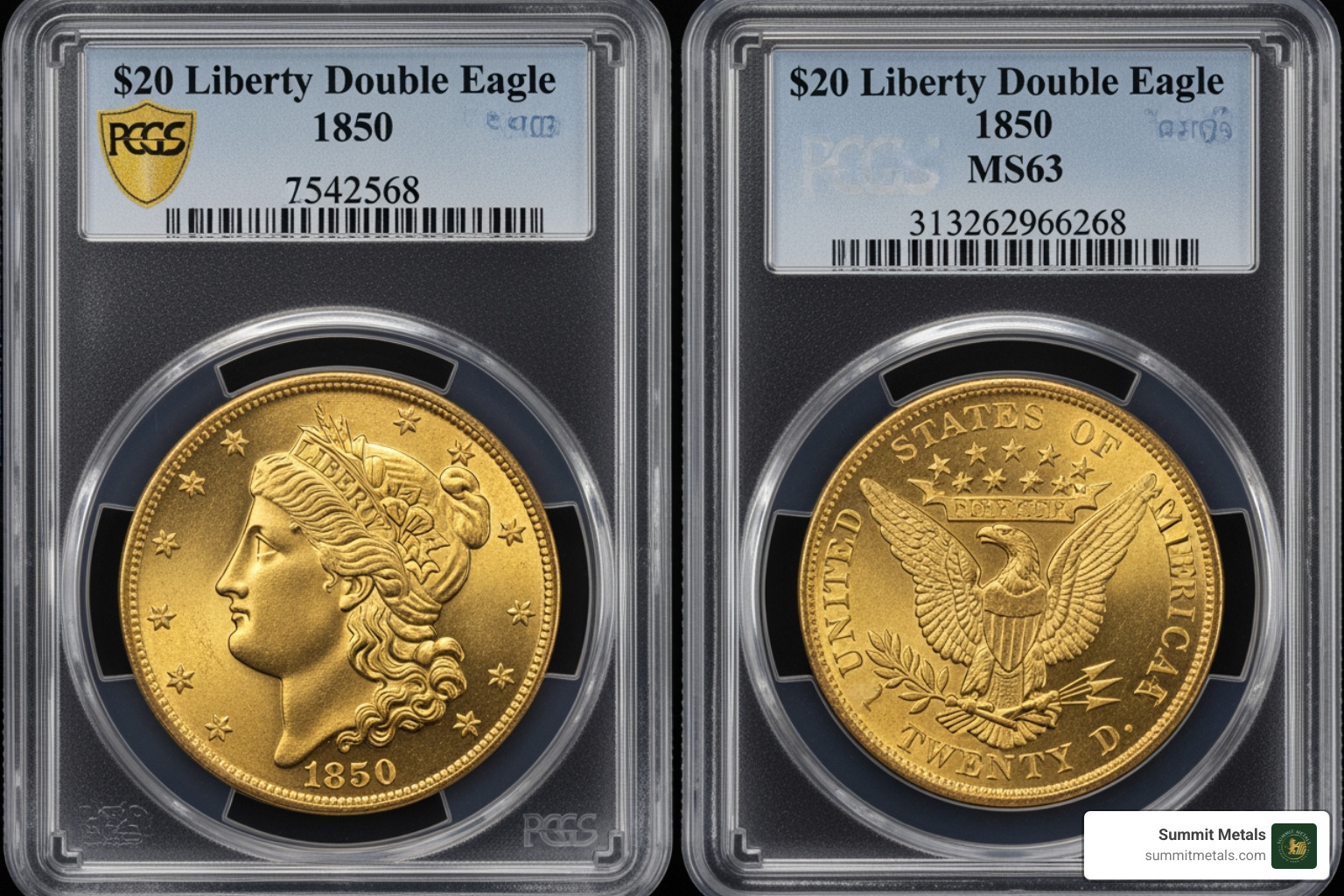
The condition, or "grade," of an 1850 $20 liberty gold double eagle is paramount to its value. Coins are graded on a 70-point scale, with higher numbers indicating better preservation.
- Circulated Grades (VF, EF): These coins show considerable wear from extensive commercial use. Very Fine (VF) and Extremely Fine (EF) examples are readily available in the numismatic market. While worn, they often retain enough detail to appreciate Longacre's design and are generally more accessible for collectors. The Philadelphia issues in these grades are more common than their New Orleans counterparts.
- About Uncirculated (AU): Coins in this range show only slight traces of wear on the highest points of the design. They are considerably scarcer than VF or EF pieces. An AU-58, for instance, is a very attractive coin, often just a whisper away from Mint State.
- Mint State (MS): These are coins that have never been circulated and retain their original mint luster. Mint State pieces are rare for the 1850 issue. Most Mint State examples found grade MS-60, MS-61, or MS-62. Examples in MS-63 are very rare, and above that (MS-64, MS-65), they are exceedingly rare, with only a handful known. Only two Gem (MS-65 or higher) examples are known for the 1850 Philadelphia issue, with one residing in the American Numismatic Society collection.
The 1850 $20 liberty gold double eagle is renowned for being among the best-struck Type One double eagles. This means we often find nearly full detail on Liberty's hair, sharp radial lines in the stars, and well-defined denticles on the obverse. The reverse typically boasts a sharp strike with good detail on the eagle's feathers. Collectors should look for minimally abraded fields, as many examples show some bag marks from their time at the mint. Raised die polishing marks are also common and are mint-made, not to be confused with hairlines from cleaning.
Luster on these coins can range from a frosty, slightly grainy texture to semi-prooflike reflectivity. Coins with natural coloration, from rich green-gold to medium orange-gold, are highly prized. Overall, the eye appeal of the 1850 is often above average for the series, making it a rewarding coin to find in good condition.
Market Prices for the 1850 $20 Liberty Gold Double Eagle
The market for the 1850 $20 liberty gold double eagle is robust, driven by its historical significance, rarity, and inherent gold value. Prices shown are at the time of this publication.
Here's a general idea of typical market prices across different grades:
- Very Fine (VF-30 to VF-35): For a Philadelphia issue, you might expect prices ranging from $2,500 to $3,500. The 1850-O in this grade would be considerably higher, often starting around $5,000 to $7,000.
- Extremely Fine (EF-40 to EF-45): Philadelphia issues typically fall into the $3,000 to $4,500 range. For the scarcer 1850-O, prices can jump to $9,000 to $12,000.
- About Uncirculated (AU-50 to AU-58): A nice Philadelphia AU example generally commands $4,000 to $8,000. The 1850-O in AU can fetch anywhere from $17,000 to $25,000+, reflecting its extreme rarity in this condition.
- Mint State (MS-60 to MS-62): Entry-level Mint State Philadelphia examples are solid five-figure coins, typically over $10,000 for MS-60 and around $26,500 for an MS-61. An MS-62 can reach $35,000 to $50,000. The single graded uncirculated 1850-O (MS-61) sold for a remarkable $111,625 in a 2014 auction.
- Gem Mint State (MS-63 to MS-65): These are exceedingly rare. An MS-63 Philadelphia can easily exceed $75,000. The current auction record for an 1850 Philadelphia Double Eagle was set in the 2007 FUN sale when an NGC MS-65 realized an astonishing $161,000. A PCGS MS-61 example sold for $52,800 in March 2018 as part of the Vanderbilt Collection. Few known MS-64 Philadelphia pieces have sold for around $200,000.
These prices are influenced by several factors: the fluctuating spot price of gold, collector demand (which is consistently high for this first-year issue), and, of course, the coin's certified grade and eye appeal. When you pair market data from third-party resources with Summit Metals' transparent, real-time pricing and clear buyback options, you can make more informed decisions about when to buy, add through Autoinvest, or eventually sell to us as part of a long-term strategy.
Are there any notable varieties or errors associated with the 1850 Liberty Head Double Eagle?
While the 1850 $20 liberty gold double eagle is generally free of dramatic errors, there are minor die variations that numismatists observe. The most commonly noted varieties involve the digit "5" in the date, appearing as either a "Closed 5" or an "Open 5." However, these varieties do not typically command a price premium over the standard issue. Collectors often focus more on the overall strike, surface quality, and originality of the coin rather than these minor distinctions.
Investing in History: The Double Eagle as a Tangible Asset
Investing in an 1850 $20 liberty gold double eagle is more than just buying gold; it's acquiring a piece of American history with tangible value. These coins offer a unique blend of intrinsic metal value and numismatic premium, making them attractive to both investors and collectors.
The key factors contributing to its value and collectibility are:
- Historical Significance: As the first regular-issue $20 gold coin, directly linked to the California Gold Rush, it holds a special place in U.S. monetary history.
- Rarity in High Grades: Despite a relatively high mintage, very few survive in Mint State, driving up their value significantly.
- Substantial Gold Content: Each coin contains 0.9675 troy ounces of pure gold, providing a solid hedge against inflation and economic uncertainty.
- Aesthetic Appeal: James B. Longacre's classic Liberty Head design is widely admired for its beauty and craftsmanship.
- Collector Demand: Being a first-year issue, the 1850 is in high demand among date collectors and those assembling type sets.
What are the future prospects for the value and collectibility of the 1850 Liberty Head Double Eagle?
The future prospects for the 1850 $20 liberty gold double eagle are exceptionally strong. As fewer coins remain in existence over time, and as interest in historical U.S. coinage continues to grow, we expect their value to increase. These coins serve as an excellent hedge against inflation, preserving purchasing power through their intrinsic gold value. Beyond that, their numismatic appeal provides an additional layer of value that standard gold bullion simply doesn't offer. The consistent demand, especially for well-preserved examples, indicates a healthy long-term market.
Summit Metals clients often pair a historic piece like the 1850 Double Eagle with a systematic accumulation plan using our Autoinvest service—committing a set dollar amount every month, much like contributing to a 401k. This dollar-cost averaging approach smooths out price swings and steadily builds a position in gold and silver over time.
Gold Coins vs. Gold Bars: Why the Double Eagle Shines
While both gold coins and gold bars offer the benefits of physical gold ownership, the 1850 $20 liberty gold double eagle stands out for several reasons:
| Feature | Gold Coin (e.g., 1850 Double Eagle) | Gold Bar (Generic) |
|---|---|---|
| Face Value | Yes ($20 USD) – legal-tender, government guaranteed | No legal-tender face value |
| Protection Against Fraud | Detailed, well-known design and fixed face value add layers of verification and recognition | Relies mainly on stamp and assay marks; fewer built‑in design diagnostics |
| Numismatic Premium | Significant, especially for rare historical coins; value can rise beyond gold price | Minimal; value tracks spot gold closely |
| Potential for Appreciation | Two drivers: gold content and collector demand | Primarily driven by spot gold price only |
| Divisibility & Liquidity | Standardized denominations; easy to sell individually into a broad global coin market | Larger bar sizes may require selling in bigger chunks; fewer collector buyers |
| Government Guarantee | Weight and purity guaranteed by the issuing government | Backed by private refiners/mints; quality varies |
| Collectibility & Story | High – history, art, and provenance make each coin unique | Low – usually treated as interchangeable bullion |
| Market Recognition | High; classic U.S. coins are recognized worldwide | Depends on refiner brand and size |
Because of the legal-tender face value and the easily recognized design, coins like the 1850 $20 liberty gold double eagle offer an added level of reassurance. Their government-issued status and intricate, widely documented design details make sophisticated counterfeits easier to detect compared with many generic bars.
Building Your Collection with Smart Strategy
Collecting and investing in historical gold coins like the 1850 $20 liberty gold double eagle requires a strategic approach. We always recommend focusing on authenticated pieces, ideally graded by reputable services like PCGS or NGC. This ensures you're acquiring genuine coins with an impartial assessment of their condition.
A simple, disciplined way to grow your holdings is through dollar-cost averaging. Instead of trying to time the market, you commit a fixed dollar amount on a regular schedule—monthly or quarterly—much like contributing to a 401k. At Summit Metals, our Autoinvest service makes this easy: you can set a recurring purchase plan, automatically adding gold and silver at transparent, real-time prices so you steadily build wealth in precious metals without having to watch the market every day. Learn more about setting up your consistent investment strategy with our Autoinvest services.
Finally, a key part of any investment strategy is considering your exit plan from day one. When the time comes to sell, liquidity and ease of transaction are crucial. Summit Metals offers services to help you liquidate your precious metals efficiently and at competitive rates through our Sell to Us program. For high-value items like the 1850 $20 liberty gold double eagle, storing them in a secure private vault can both protect your asset and make it easier to sell quickly when you are ready—your coins remain documented, authenticated, and ready for a smooth transaction.
Frequently Asked Questions about the 1850 Double Eagle
How much gold is in an 1850 Double Eagle?
An 1850 $20 liberty gold double eagle contains a substantial amount of gold: 0.9675 troy ounces of pure gold. The coin itself is composed of 90% gold and 10% copper. This alloy was standard for U.S. gold coinage of the era, chosen to provide durability and resist wear in circulation, as pure gold is quite soft. Its total weight is 33.436 grams, with a diameter of 34 mm. This significant gold content is a primary driver of its intrinsic value.
Is the 1850 Double Eagle a rare coin?
Yes, while the original mintage figures (1,170,261 from Philadelphia and 141,000 from New Orleans) might seem high, the 1850 $20 liberty gold double eagle is indeed a rare coin, particularly in higher grades. Most survivors are in circulated condition, such as Very Fine (VF) or Extremely Fine (EF), due to their extensive use in commerce. Mint State (uncirculated) examples are very scarce, with fewer than 100 believed to exist across both mints. Gem quality pieces (MS-65 or higher) are exceedingly rare, with only a couple known. This combination of historical significance, substantial gold content, and scarcity in top conditions makes it highly sought after by collectors.
How can I tell if my 1850 Double Eagle is real?
Authenticating an 1850 $20 liberty gold double eagle requires a keen eye and, ideally, expert knowledge. Key indicators include precise weight (33.436 grams), diameter (34 mm), and specific design details consistent with James B. Longacre's original work. Counterfeits often have incorrect weight, off-color gold, or slight deviations in design elements. The reeded edge should also be examined closely.
However, the most reliable method of verification for such a valuable and historically significant coin is professional grading by a third-party service like the Professional Coin Grading Service (PCGS) or the Numismatic Guaranty Corporation (NGC). These services encapsulate the coin in a tamper-evident slab and provide an impartial, expert assessment of its authenticity and condition, giving both buyers and sellers confidence.
Secure a Piece of American Legacy
The 1850 $20 liberty gold double eagle is more than just a coin; it's a tangible link to America's past, a testament to the nation's rapid expansion and economic might during the California Gold Rush. Its blend of historical significance, artistic design, and intrinsic gold value makes it a compelling asset for both seasoned numismatists and astute investors.
Whether you're drawn to its story, its beauty, or its potential as a store of wealth, acquiring an 1850 $20 liberty gold double eagle means securing a piece of American legacy. At Summit Metals, based in Wyoming and serving clients in Salt Lake City, Utah, we are dedicated to helping you steer precious metals, offering authenticated gold and silver for investment with transparency and value.
You don't have to build your position all at once. Many investors choose to use our Autoinvest program to buy every month—just like contributing to a 401k—so they can dollar-cost average into historic and modern gold without trying to time the market. And when you are ready to rebalance or liquidate, our Sell to Us service provides a clear exit strategy, especially if you've safeguarded your holdings in private vault storage to keep them secure and ready for sale.
We invite you to explore our wider collection of American gold coins and find other pieces of history that can enrich your portfolio. For more information on iconic U.S. gold coinage, check out Explore our collection of American Gold Eagle coins.


