

Why Storing Silver Bars Requires a Different Strategy Than Gold
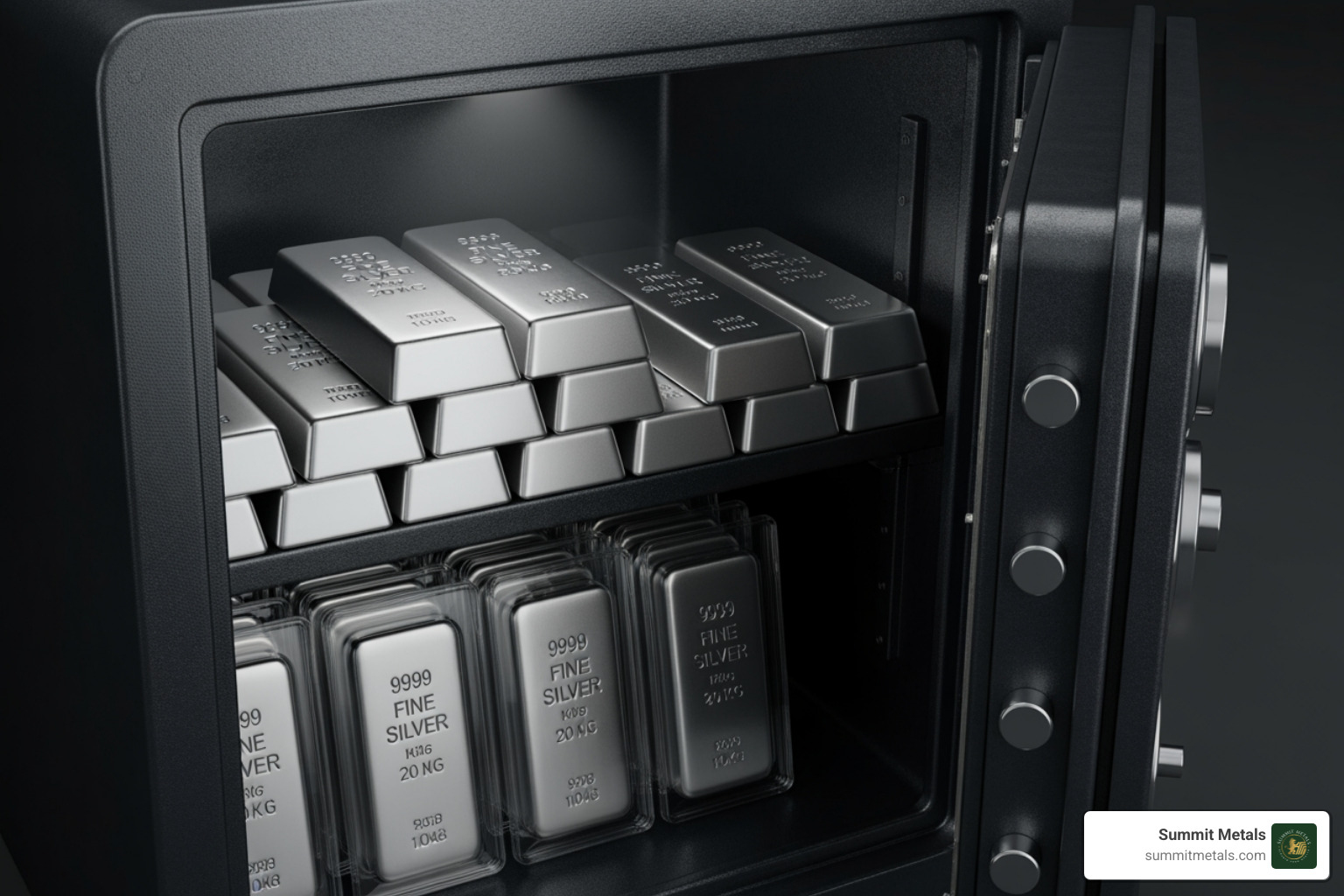
To store silver bars safely, you need to control three things: humidity (keep it below 50%), temperature (steady 60-70°F), and access (either a bolted 500+ lb home safe or a professional depository). Silver tarnishes when exposed to sulfur compounds in the air, so airtight containers with desiccants are essential. Unlike gold, silver takes up 128 times more space per dollar value, making storage density a real challenge.
Quick Storage Checklist:
- At Home: Use a fireproof, waterproof safe (500+ lbs), bolt it down, and add silica gel packets
- Bank Box: Limited access, no insurance, size constraints—most boxes fit only 2-4 kilo bars
- Depository: Full insurance, segregated storage, easy liquidation when you're ready to sell to us
- Never Use: PVC flips, rubber bands, acidic paper, or damp basements
You just acquired your first silver bars. Maybe you bought a few 1 oz minted pieces to test the waters, or you went all-in on a 100 oz cast bar because the premium was lower. Either way, you now face a problem most gold investors never think about: where do you put all this metal?
Silver isn't gold. A $50,000 stack of gold weighs about 2.6 pounds and fits in your hand. The same value in silver? 189 pounds spread across ten large shoe boxes. That's not a problem you can solve with a sock drawer.
But size is only half the story. Silver reacts with sulfur compounds in the air, forming black tarnish that can slash resale value by hundreds of dollars per bar. Humidity above 50% accelerates this process. Temperature swings cause condensation, which speeds corrosion. And unlike gold, which shrugs off almost any environment, silver demands a controlled storage strategy from day one.
The good news? You have options. Keep a small stash at home for immediate access during a crisis. Use a bank safe deposit box for mid-sized holdings if you value convenience over insurance. Or partner with a professional depository for full security, insurance, and liquidity when you're ready to sell to us. Each approach has trade-offs in cost, access, and peace of mind.
I'm Eric Roach, and during my decade on Wall Street I helped Fortune 500 companies hedge billions in commodities—including precious metals. Today I guide everyday investors on how to store silver bars securely while maintaining a clear exit strategy through Summit Metals' sell-to-us program.
To help highlight why silver storage is so different from gold storage, consider this comparison:
| Feature | Silver Bars (by value) | Gold Bars (by value) |
|---|---|---|
| Weight & Volume | ~128x more volume than gold for same dollar value | Extremely compact; easy to store in small safes |
| Environmental Sensitivity | Reacts with sulfur; tarnishes without protection | Chemically inert; far less affected by environment |
| Typical Home Storage Need | Larger, heavier safe; more space | Small, high-quality safe often sufficient |
| Ideal Use of Depositories | Very helpful once holdings grow beyond a few boxes | Useful, but less critical purely for space reasons |
Find more about store silver bars:
- precious metals storage
- physical silver investment
- counterfeit silver bullion
Understanding Your Silver: Types, Sizes, and Value Factors
Before we dive into storage solutions, let's understand what we're protecting. Silver bars come in various types and sizes, each with characteristics that influence its value and storage needs. Most investment-grade silver bars are .999 or .9999 fine (99.9% or 99.99% pure silver), a standard for marketability.
Choosing products from reputable mints and refiners like the Royal Canadian Mint, Sunshine Mint, Germania Mint, Asahi Refining, and Valcambi is a best practice. These mints often include security features to validate authenticity, giving you peace of mind.
Beyond the spot price of silver, the most significant factor is the premium: the amount you pay above the spot price, which covers manufacturing and distribution. Generally, larger bars have lower premiums per ounce, making them more cost-effective for bulk investments.
To help you decide between silver bars and coins, here's a quick comparison:
| Feature | Silver Bars | Silver Coins |
|---|---|---|
| Premiums | Lower per ounce, especially for larger sizes. | Generally higher due to minting costs. |
| Stackability | Excellent. Uniform shapes are easy to store. | Less space-efficient unless in mint tubes. |
| Liquidity | Highly liquid, but larger bars are less divisible. | Highly liquid and easily divisible. |
| Government Backing | No legal tender value. | Often have a face value and government backing. |
| Counterfeit Risk | Can be a target. Buy from reputable dealers. | Also a target, but many have advanced security features. |
Because coins often carry a legal-tender face value, that government backing can offer an additional layer of protection against certain types of fraud and can make them easier to recognize and trade globally. Bars, on the other hand, usually offer more silver for your dollar, which appeals to investors focused on maximizing ounces.
To round out the picture for portfolio builders, here is a broader comparison that includes gold formats:
| Feature | Silver Bars | Silver Coins | Gold Bars | Gold Coins |
|---|---|---|---|---|
| Typical Premium (Relative) | Lowest per ounce for larger sizes | Higher than bars | Competitive, lower on larger weights | Often highest due to collectability and minting |
| Storage Efficiency | Bulky vs. value; needs more space | Moderate; tubes and boxes help | Extremely efficient per dollar | Very efficient; small, easy to secure |
| Government Face Value | No | Often yes | Rarely | Common; legal tender |
| Protection Against Certain Frauds | Relies on refinery marks and testing | Legal-tender status plus security features | Refinery marks and assays | Legal tender plus advanced security; widely recognized |
| Best For | Maximizing silver ounces per dollar | Blending liquidity, recognizability, and government backing | Concentrated wealth in compact form | Highly portable, widely accepted, fraud-resistant wealth |
If you plan to build your position methodically over time, Summit Metals' Autoinvest options let you dollar-cost average into silver and gold by purchasing every month, similar to contributing to a 401k. Rather than trying to time the market, you steadily increase your stack in a disciplined way.
Minted vs. Cast vs. Hand-Poured Bars
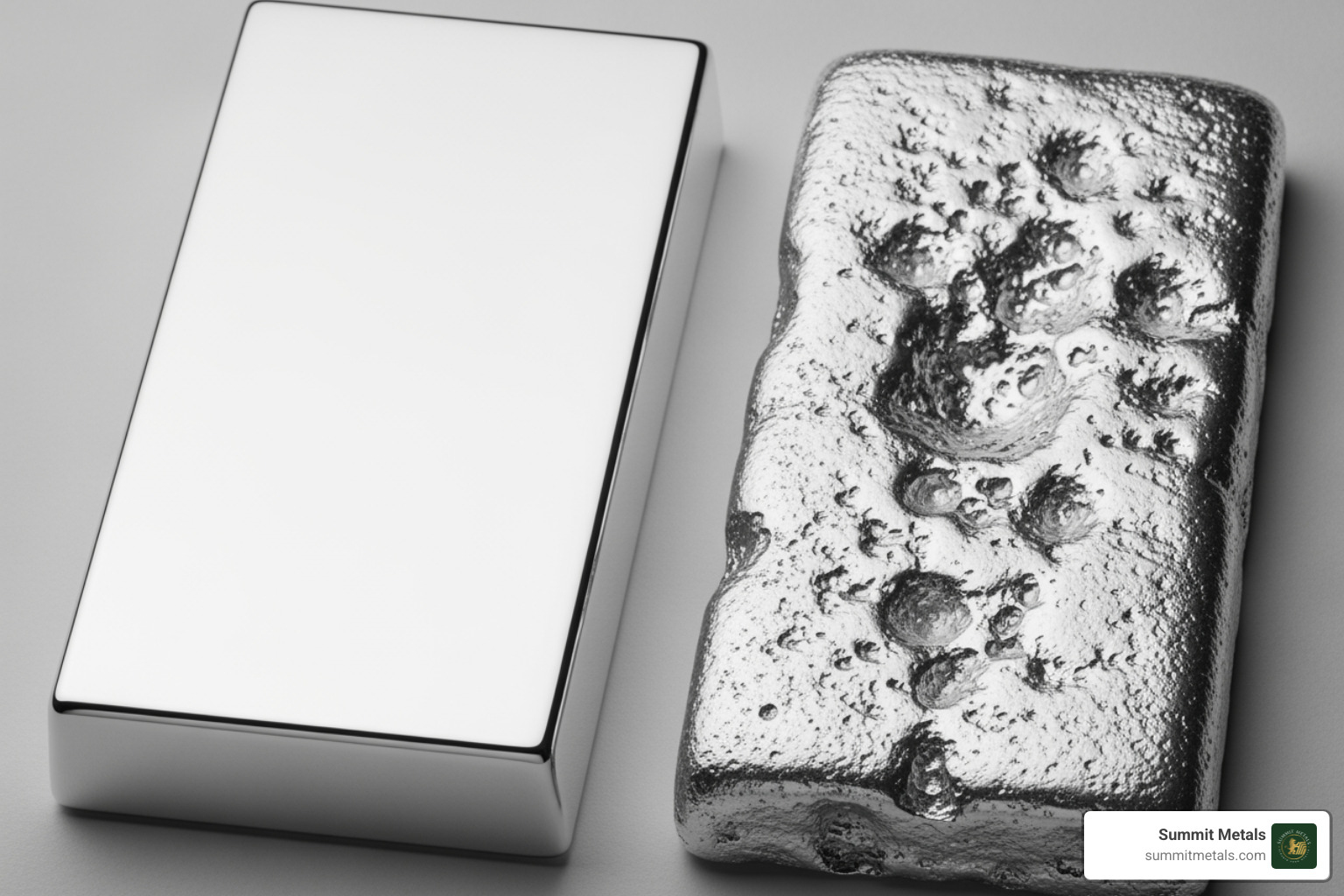
Silver bars come in different forms, each with its own appeal:
- Minted Ingots: Machine-pressed with a uniform, polished finish. Their precise dimensions make them ideal for stacking, and many come in assay cards for easy verification.
- Cast-Poured Bars: Created by pouring molten silver into a mold, resulting in a rustic look with unique, irregular shapes.
- Hand-Poured Bars: A subset of cast bars, these are made by smaller refiners and have a distinct, artisanal appeal.
Regardless of the type, most silver bars we deal with at Summit Metals maintain the highest purity standards, ensuring your investment is sound.
Popular Silver Bar Sizes and Their Impact on Storage
The size and weight of your silver bars profoundly impact storage and transportation.
- 1 oz & 10 oz bars: These are great for new investors and offer flexibility. They are easy to store, trade, and are perfect for dollar-cost averaging. Our AutoPay program lets you automatically purchase silver monthly, similar to a 401k, to build your stack consistently. You can also use our broader Autoinvest approach to schedule recurring purchases in the sizes that fit your budget.
- Kilo (32.15 oz) & 100 oz bars: These larger bars offer lower premiums, making them cost-effective for serious investors. However, their size and weight (a 100 oz bar is over 6 pounds) make home storage and transport more challenging.
How Size Impacts Your Strategy:
- Storage Density: Larger bars mean fewer pieces to manage, but silver's lower density compared to gold means it always takes up more space.
- Transportability: Smaller bars are easier to move and conceal in an emergency.
- Liquidity: Smaller bars offer greater flexibility for selling in smaller increments. You can't break a 100 oz bar to sell a small portion.
If you're looking to build your silver holdings, our subscription services can help you acquire various sizes of bars and rounds over time, making dollar-cost averaging simple and effective and keeping your storage plan aligned with your long-term goals.
How to Store Silver Bars Securely at Home
Storing silver at home offers immediate access and full control, but it requires careful planning to mitigate risks.
Pros of home storage:
- Immediate access: Your silver is available 24/7, which is crucial in an emergency.
- Full control: You manage the security and privacy of your investment without third-party involvement.
Cons of home storage:
- Theft risk: Homes are more vulnerable than vaults. A heavy, bolted-down safe (500+ lbs) is essential to deter burglars.
- Disaster risk: Fire and floods can damage or destroy your investment, even in a safe.
- Insurance challenges: Standard homeowner's insurance offers limited coverage for precious metals. Securing full coverage can be expensive and complex.
Best Practices for Home Storage
If you choose to store silver bars at home, follow these security measures:
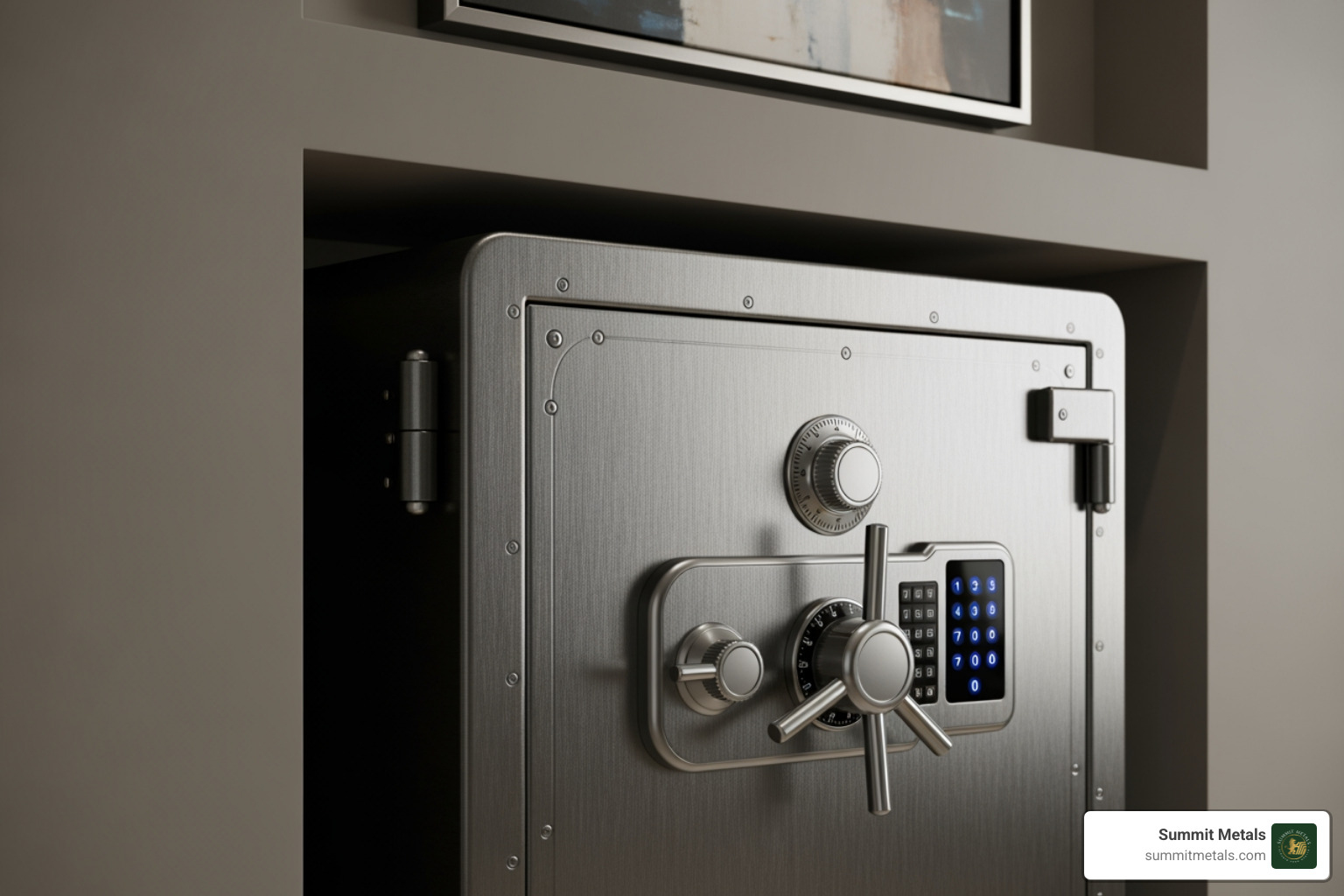
- Invest in a Quality Safe: Choose a fireproof (1-hour at 1200°F) and waterproof safe. It should be heavy (500+ lbs) and bolted to the floor to prevent removal.
- Choose a Discreet Location: Avoid obvious places. A hidden compartment or an unconventional spot is better than a master closet.
- Maintain Secrecy: The fewer people who know about your silver, the safer it is.
- Use Decoys Wisely: Some investors keep a small amount of less valuable items in an obvious place as a decoy while their main holdings remain hidden and secured.
- Diversify Storage: For larger holdings, consider splitting your assets between a home safe and a professional depository to spread risk.
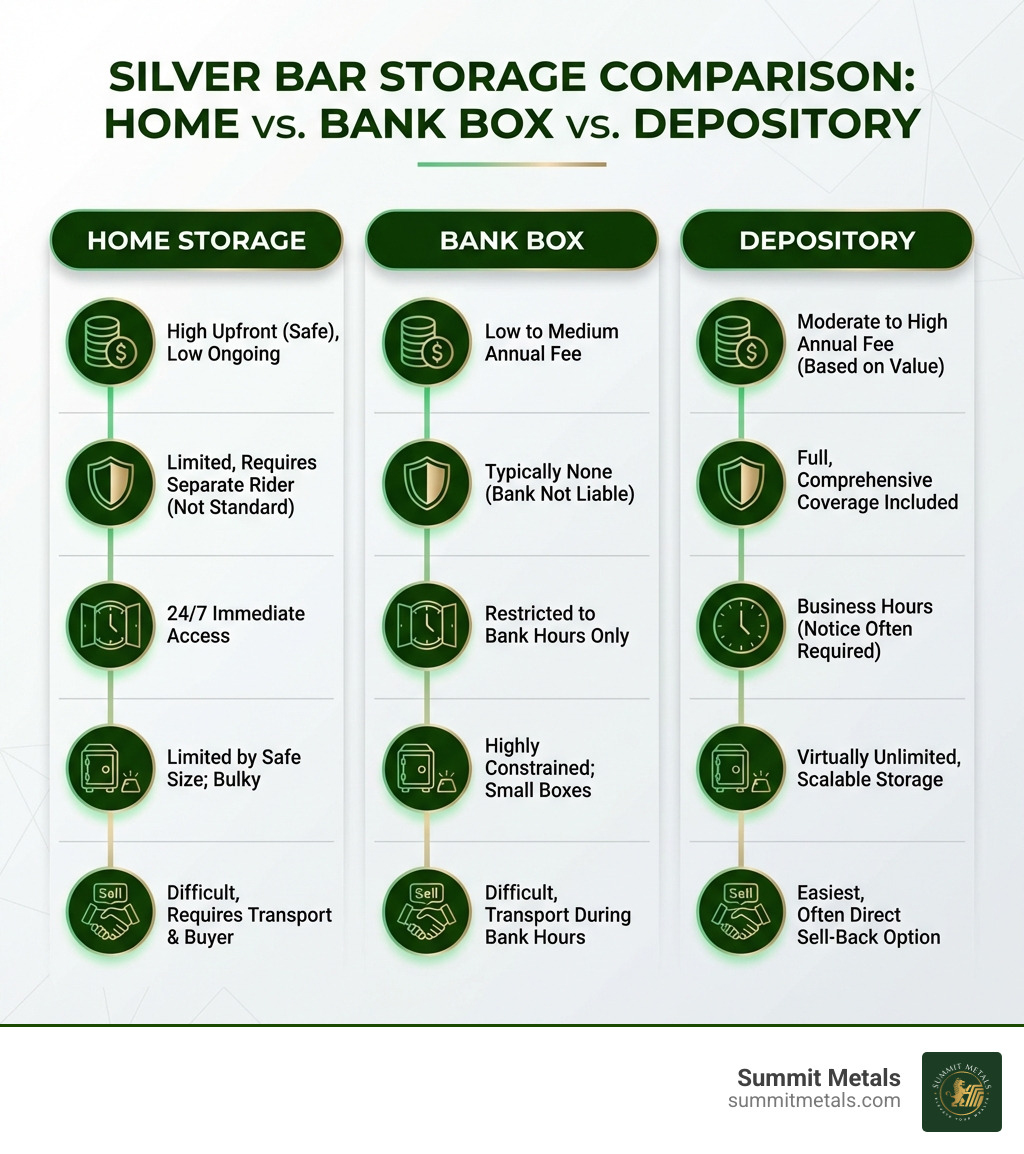
A simple way to think about the choice between home storage and a private vault is to compare their main trade-offs:
| Factor | Home Safe | Private Vault / Depository |
|---|---|---|
| Access | 24/7, immediate | Business hours or scheduled access |
| Theft Protection | Depends on safe and secrecy | Professional, institutional-grade security |
| Disaster Protection | Good if fire/water rated, but not perfect | Purpose-built facilities, high resilience |
| Insurance | Often limited, may need rider | Typically included and comprehensive |
| Best Use Case | Emergency stash, smaller holdings | Larger stacks, long-term wealth protection |
Protecting Your Silver from Environmental Damage
Tarnish, a black or brown layer of silver sulfide, can reduce your silver's resale value. Here’s how to prevent it:
- Control the Environment: Store silver in a cool, dry place with low humidity (ideally 30-40%). Avoid basements or garages.
- Use Airtight Storage: Keep bars in sealed, airtight containers made of inert materials.
- Add Desiccants: Place silica gel packets or anti-tarnish strips inside containers to absorb moisture and neutralize sulfur.
- Avoid Harmful Materials: Keep silver away from cardboard, rubber bands, and PVC plastics, which can cause permanent damage.
- Handle with Gloves: Use clean cotton gloves to prevent skin oils from causing spots. Wrap bars in soft, acid-free cloth to prevent scratches.
Off-Site Storage: Bank Safe Deposit Boxes vs. Professional Depositories
As your silver stack grows, home storage becomes less practical. At this point, it's time to consider third-party storage options, balancing security, access, and cost.
The Pros and Cons of a Bank Safe Deposit Box
A bank safe deposit box is a common first step, but it has significant drawbacks for serious silver investors.
Pros:
- Convenience: Banks are easily accessible in most towns.
- Perceived Security: Bank vaults offer a higher level of security than a typical home.
Cons:
- Limited Access: You can only access your holdings during banking hours.
- No Insurance: The contents of safe deposit boxes are typically not insured by default.
- Bank Failure or Operational Risk: If a bank closes or has operational issues, accessing your assets can become a complicated and lengthy process.
- Size Limitations: Silver is bulky. Most safe deposit boxes can only hold a few kilo bars, making them unsuitable for large quantities.
Key considerations when you store silver bars in a depository
For maximum security and peace of mind, a professional precious metals depository is the superior choice for storing silver bars. These facilities are designed specifically for high-value assets.
- Professional Security: Depositories offer 24/7 surveillance, armed guards, and advanced access controls that far exceed home or bank security.
- Full Insurance Coverage: Your holdings are fully insured against theft, damage, and loss, often by major underwriters.
-
Segregated vs. Allocated Storage:
- Segregated: Your exact bars are stored separately. You get back the same items you deposited.
- Allocated: Your silver is pooled with others, but you own a specific quantity of it.
- Independent Audits: Regular audits by third parties verify that your metals are physically present and accounted for.
- Storing for Liquidity: A key advantage of using a depository that works closely with a dealer like Summit Metals is streamlined selling. You can design your plan so that metals stored in a private vault are already positioned for quick sale when you choose to sell to us, without having to ship heavy bars around.
To make the choice between a bank box and a professional depository clearer, consider this side-by-side comparison:
| Feature | Bank Safe Deposit Box | Professional Depository |
|---|---|---|
| Primary Purpose | General valuables | Precious metals storage |
| Insurance | Usually not included | Typically included and specific to metals |
| Access Hours | Bank hours only | Often extended or by appointment |
| Capacity for Silver | Limited; not ideal for large stacks | Scales easily to very large holdings |
| Documentation & Audits | Minimal | Regular third-party audits |
| Ease of Liquidation | You must retrieve and ship metals yourself | Can often sell directly from vault via dealer partnership |
If you plan to build a substantial position through Autoinvest or recurring purchases, thinking about depository storage early can make your eventual exit—when you decide to sell to us—much smoother and faster.
Frequently Asked Questions about Storing Silver Bars
How can I protect my silver bars from tarnishing?
Tarnish is a chemical reaction with sulfur that creates a black or brown layer on silver, potentially reducing its resale value. To prevent it:
- Control the Environment: Store silver in a cool, dry place with low humidity (ideally 30-40%). Avoid basements or garages.
- Use Airtight Storage: Keep bars in sealed, airtight containers made of inert materials.
- Add Desiccants: Place silica gel packets or anti-tarnish strips inside containers to absorb moisture and neutralize sulfur.
- Avoid Harmful Materials: Keep silver away from cardboard, rubber bands, and PVC plastics, which can cause permanent damage.
- Handle with Gloves: Use clean cotton gloves to prevent skin oils from causing spots.
Preventing tarnish is easier than removing it. Aggressive cleaning can damage a bar's finish and lower its value.
What are the most common mistakes when storing silver?
Avoid these common pitfalls to protect your investment:
- Ignoring Humidity: Storing silver in a damp, unsealed environment is the fastest way to cause tarnish.
- Using Wrong Containers: PVC holders, certain plastics, and cardboard boxes can release chemicals that damage silver.
- Not Protecting from Scratches: Stacking bars without soft separators can cause scratches and dings, reducing their appeal.
- Poor Record-Keeping: Failing to document your holdings (serial numbers, photos, purchase dates) can create problems for insurance or estate purposes.
How much does it cost to store silver bars?
Storage costs vary by method:
- Home Storage: The main cost is a high-quality safe ($500 - $2,000+), plus ongoing costs for supplies like desiccants. You may also need a separate insurance rider.
- Bank Safe Deposit Box: Annual fees typically range from $50 to $300, but this does not include insurance for the contents, and space is very limited.
- Professional Depository: Fees are usually a small percentage of the stored value (e.g., 0.25% to 1% annually). This cost includes full insurance, top-tier security, and easy liquidation, making it a cost-effective option for serious investors.
If you are dollar-cost averaging into silver and gold using recurring purchases—similar to setting up a 401k contribution—it becomes even more important to choose a storage solution that scales easily as your holdings grow and that keeps your metals ready to liquidate through a clear exit plan, such as storing in a private vault and later choosing to sell to us.
Conclusion: Securing Your Silver for the Future
Investing in silver bars is a smart move for diversifying your portfolio and preserving wealth. However, the unique physical characteristics of silver – its bulkiness and susceptibility to tarnishing – demand a thoughtful and strategic approach to storage.
We've explored the various options for how to store silver bars, from the accessibility and control of home storage to the robust security and comprehensive insurance of professional depositories. While home storage offers immediate access, it comes with inherent risks of theft and environmental damage that require careful mitigation through heavy, bolted-down safes and meticulous environmental control. Bank safe deposit boxes provide a convenient middle ground but fall short on insurance coverage and capacity for larger silver holdings. For ultimate security, full insurance, and streamlined liquidity, professional depositories stand out as the superior choice for significant investments.
Whichever path you choose, it helps to think in terms of the full life cycle of your investment—how you buy, how you store, and how you eventually sell. Many investors use an Autoinvest or subscription-style approach to accumulate metals every month, much like a 401k. As your stack grows, shifting more of your holdings into a private vault can make it much easier to execute your exit strategy.
Regardless of your chosen method, remember the critical importance of an exit strategy. At Summit Metals, we're not just about helping you acquire precious metals; we're committed to ensuring you have a clear and efficient path to liquidate your assets when the time comes. Structuring your storage so that metals held in a private vault are already positioned to be liquidated when you decide to sell to us can turn a complex process into a simple instruction.
By understanding your silver, making informed decisions about storage, and partnering with a trusted dealer like Summit Metals, you can build your silver stack with confidence, knowing it's protected for the future. For more insights into optimizing your precious metals portfolio, read our guide on What is the best silver or gold to buy and why liquidity matters.


