

Is Silver a Real Inflation Hedge? Here's What the Data Shows

The silver price inflation hedge is not just a theory — it's backed by decades of hard data, and right now, it matters more than ever.
Here's a quick answer before we dive deeper:
| Period | Silver Price Start | Silver Price End | Gain |
|---|---|---|---|
| 1970–1980 (Stagflation) | ~$1.60/oz | ~$50/oz | ~3,025% |
| 2008–2011 (Post-Crisis) | ~$9/oz | ~$49/oz | ~444% |
| 2020–2025 (Post-COVID) | ~$12/oz | ~$54/oz | ~350% |
| 2025 YTD (as of Oct 23) | ~$30/oz | ~$54/oz | ~46% |
Bottom line: Every major inflation surge of the last 50 years has been followed by a significant rise in silver prices — often outpacing both inflation and the stock market.
But silver is not a simple "set it and forget it" hedge. It's volatile, it's industrial, and it behaves differently from gold. Understanding those differences is what separates smart silver investors from frustrated ones.
That's exactly what this guide is here to do — cut through the noise and give you a clear, honest picture of how silver protects purchasing power, when it works best, and how to use it wisely in your portfolio.
I'm Eric Roach — a former Wall Street investment banker who has helped clients structure precious metals strategies as a practical silver price inflation hedge alongside traditional portfolios. Over more than a decade advising Fortune 500 companies on risk and hedging, and now helping everyday investors do the same, I've seen how silver can quietly anchor a portfolio when inflation chips away at everything else.
Key silver price inflation hedge vocabulary:
Understanding Inflation and the Erosion of Purchasing Power
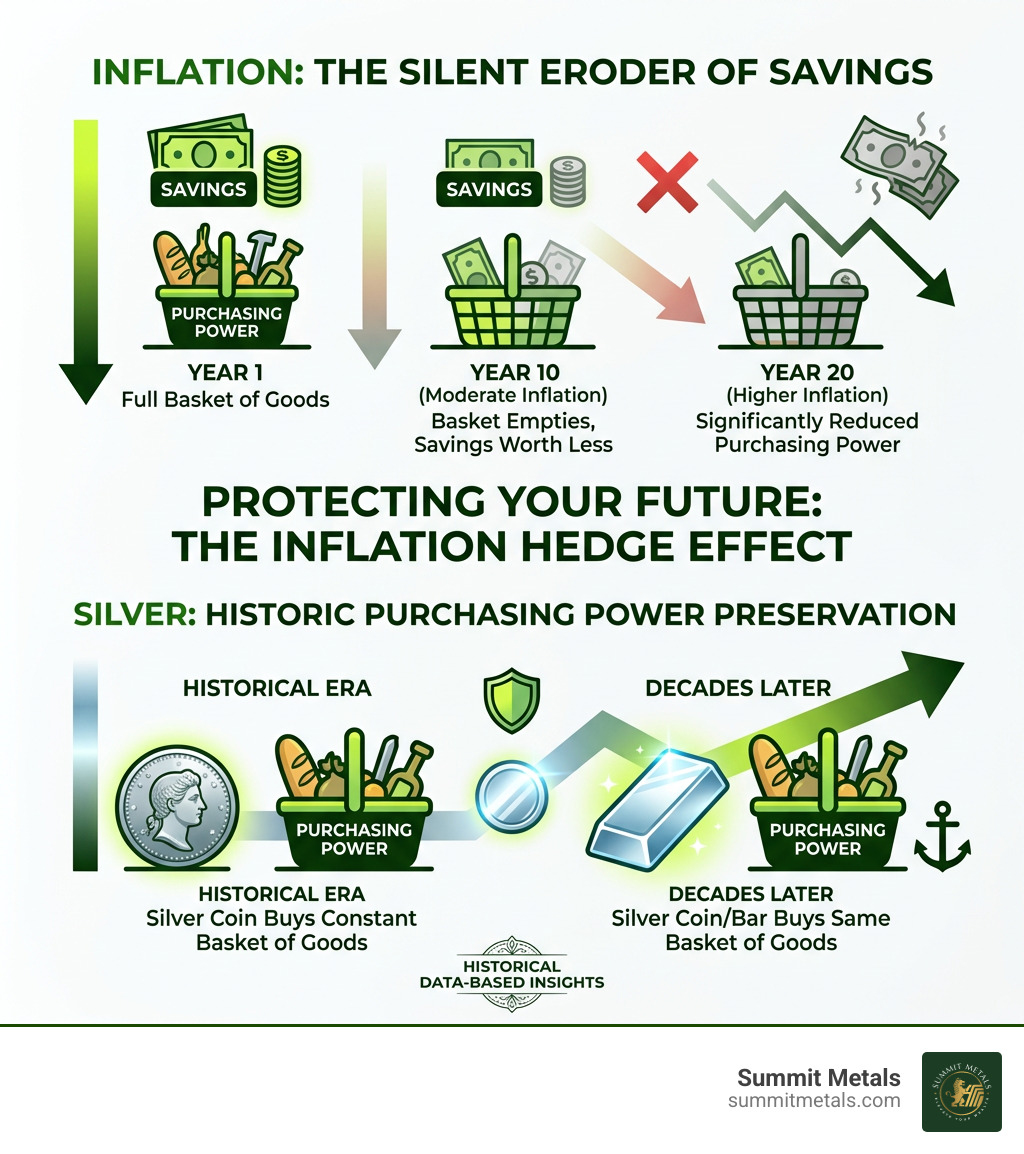
To understand why a silver price inflation hedge is necessary, we first have to look at the "silent thief" in your bank account: inflation. Most of us feel inflation at the grocery store or the gas pump, but its technical definition is the slow loss of purchasing power of a currency over time.
In the U.S., we track this through the Consumer Price Index (CPI), which follows a "basket of goods" including everything from rent to milk. When the government prints more money—as we saw during the post-2008 quantitative easing and the 2020 pandemic response—more dollars begin chasing the same amount of goods. This leads to the declining power of the US Dollar, which has been a persistent trend since the gold standard was abandoned in 1971.
The real danger for savers is the "real rate of return." This is a simple but brutal calculation: take your annual investment return, subtract the inflation rate, and subtract taxes. If your high-yield savings account pays you 4% but inflation is running at 6.8% (as seen in recent years), you are actually losing 2.8% of your wealth every year. You might have more "paper" dollars, but those dollars buy fewer groceries. This is why many investors view fiat currency as an ongoing social experiment, while silver remains "real money."
Why Silver is a Historically Proven Asset
Silver has been used as a unit of value since Ancient Greece. For centuries, it was actually the primary global currency—used even more widely than gold in daily commerce. While we no longer carry silver coins in our pockets to buy bread, the metal has maintained its status as a "hard asset" that cannot be printed out of thin air.
History shows us that when the economy hits the rocks, silver tends to shine. During the 1970s stagflation—a period of high inflation and stagnant growth—silver didn't just keep up; it exploded. We’ve seen similar patterns during the 2008 financial crisis and the post-COVID surge. Because silver is a finite and expensive resource to mine, its supply cannot suddenly increase to match a spike in the money supply.
Historical Performance of the Silver Price Inflation Hedge
The numbers don't lie. During the U.S. stagflation era (1970–1980), silver prices soared by approximately 3,025%, moving from about $1.60/oz to a peak of $50/oz. This wasn't just a fluke; it was a massive transfer of wealth into tangible assets.
More recently, as of October 23, 2025, silver has delivered a 46% YTD return. Compare that to the Nifty's 9% return or the modest gains in traditional fixed-income markets, and it becomes clear why silver is being called the "next big" inflation hedge. You can see these trends for yourself on a historical price of silver graph, which illustrates how the metal "catches up" to inflation in violent, profitable bursts.
The Silver Price Inflation Hedge: Silver vs. Gold and Other Assets
When people think of inflation, they usually think of gold first. While gold is the "granddaddy" of safe havens, silver offers a different set of opportunities. Gold is often more stable, but silver is more volatile—and in investing, volatility can be your friend if you're looking for higher percentage gains.
| Feature | Silver | Gold | S&P 500 Stocks |
|---|---|---|---|
| Primary Driver | Industrial + Investment | Investment + Jewelry | Corporate Earnings |
| Volatility | High | Moderate | Moderate to High |
| Market Size | Small (~1/10th of Gold) | Large | Massive |
| Inflation Correlation | Strong (High Regimes) | Very Strong | Variable |
| Industrial Use | ~60% of Demand | ~5% of Demand | N/A |
Academic studies, including a WGC study on gold and inflation, show that while gold is a proven long-term hedge, its short-term performance can be less convincing. Silver, on the other hand, often lags behind gold at the start of an inflationary cycle but then "catches up" and frequently outperforms gold in the later stages. This is one reason why gold and silver prices fluctuate in different patterns; silver reacts not just to fear, but to industrial reality.
Industrial Demand: The Secret Weapon of a Silver Price Inflation Hedge
Unlike gold, which mostly sits in vaults, silver is being used up. It is the best conductor of electricity on the planet. This gives it silver's strategic edge in economic shifts.
Roughly 60% of annual silver demand comes from industry. It is essential for:
- Solar Panels: Photovoltaic cells require silver to function efficiently.
- Electric Vehicles (EVs): EVs use significantly more silver than internal combustion engines for their electrical systems.
- Electronics: From 5G towers to your smartphone, silver is everywhere.
This dual identity—part precious metal, part industrial essential—means that even if investment demand cools, the "green energy" revolution provides a massive floor for the price. Some experts suggest that by 2050, the EV industry alone could consume a massive portion of current global reserves.
Strategic Ways to Gain Exposure to Silver
If you’ve decided that a silver price inflation hedge belongs in your portfolio, the next question is how to buy it. You can buy silver ETFs (like SLV), mining stocks, or futures, but many of our clients at Summit Metals prefer the security of physical bullion.
Physical silver is a tangible asset you can hold in your hand. It has no counterparty risk—meaning you don't have to worry about a bank or a brokerage firm failing. When you're asking, does it make sense to invest in silver?, consider that physical metal is one of the few assets that isn't someone else's liability.
Autoinvest: Dollar-Cost Averaging Your Way to Wealth with Summit Metals
One of the biggest mistakes investors make is trying to "time the market." Silver is volatile; it can swing 5% in a single day. Instead of trying to guess the bottom, we recommend a strategy called Dollar-Cost Averaging (DCA).
At Summit Metals, we’ve made this easy with our Autoinvest program. It works just like your 401k. You set a fixed dollar amount every month, and we purchase authenticated silver for you at the current market price.
- When prices are high, your dollars buy a little less silver.
- When prices are low, your dollars buy a lot more silver.
Over time, this lowers your average cost per ounce and removes the emotional stress of watching daily price tickers. It’s a "common sense" approach to building the bullish case for silver without the headache.
Choosing Your Metal: Coins vs. Bars
Not all silver is created equal. When building your silver price inflation hedge, you'll generally choose between coins and bars.
| Feature | Silver Coins (Sovereign) | Silver Bars |
|---|---|---|
| Premiums | Higher (due to minting costs) | Lower (better for bulk) |
| Liquidity | Extremely High | High |
| Legal Tender | Yes (has a face value) | No |
| Protection | Face value offers extra legal protection | Serial numbers for security |
| Best For | New investors, small amounts | Large-scale wealth preservation |
Sovereign coins, like the Silver American Eagle or Canadian Maple Leaf, have a face value. While you wouldn't spend a silver coin for its $1 face value when the metal is worth $50, that legal tender status provides a layer of protection against fraud and makes them easily recognizable by dealers worldwide. Bars, on the other hand, are the most cost-effective way to buy silver if you're looking for the lowest price per ounce. We often tell our clients that is silver a good investment? depends largely on buying the right product for your specific goals.
Managing Risks, Volatility, and Exit Strategies
We wouldn't be doing our job if we didn't mention the risks. Silver is a small market—about 1/10th the size of the gold market. This means when big investors move in, the price can go parabolic, but it can also drop sharply when they exit.
Storage is another consideration. Unlike a digital stock, silver takes up physical space. A few thousand dollars of gold fits in a pocket; a few thousand dollars of silver requires a sturdy box. This is why tracking and understanding silver prices and having a secure storage plan is vital.
Planning Your Exit: Seamless Liquidity with Summit Metals' "Sell to Us" and Private Vault Storage
An investment is only as good as your ability to turn it back into cash when you need it. Many people buy silver but forget to plan their exit strategy.
We offer a "Sell to Us" focus that ensures our clients are never stuck with metal they can't move. By using our private vault storage in secure locations like Salt Lake City, Utah, your silver stays liquid. You don't have to worry about shipping heavy boxes or verifying purity when you're ready to sell. Since we’ve already authenticated the metal and held it in a secure chain of custody, we can offer immediate liquidity.
Understanding the gold and silver ratio can also help you time your exit. Historically, when the ratio is high (e.g., 80:1), silver is considered "cheap" compared to gold. When it narrows, it may be a strategic time to trade some of your silver for gold or cash.
Frequently Asked Questions about Silver and Inflation
Is silver a better inflation hedge than gold?
"Better" is subjective. Gold is a more stable store of value, making it great for preserving what you already have. Silver is more volatile but has higher growth potential due to its smaller market size and industrial demand. Most experts suggest a mix of both—perhaps 70% gold and 30% silver—to balance stability with growth.
How does industrial demand affect silver's price during a recession?
This is the "dual nature" of silver. During a recession, industrial demand might slow down as fewer cars and solar panels are built. However, this is often offset by a massive spike in "safe haven" investment demand as people flee the stock market. Historically, silver has outperformed the S&P 500 in three of the last eight recessions.
What are the key benefits of owning physical silver for inflation protection?
Physical silver offers privacy, no counterparty risk, and intrinsic value. Unlike a digital entry in a bank ledger, silver has been recognized as value for 5,000 years. It cannot be hacked, deleted, or devalued by a central bank's printing press.
Conclusion
At Summit Metals, we believe in protecting your hard-earned wealth with common sense. Based in Wyoming with presence in Salt Lake City, Utah, we provide authenticated precious metals with a focus on transparency. Our bulk purchasing power allows us to offer competitive rates that ensure you get more silver for every dollar you invest.
Whether you are just starting with our Autoinvest program to dollar-cost average your way to security, or you are looking for large-scale wealth preservation with our private vaulting and "Sell to Us" liquidity, we are here to help. Inflation isn't going away, but you don't have to let it erode your future.
Ready to take the first step? Start protecting your wealth with silver today.
Disclaimer: Prices shown are at the time of this publication. This guide is for educational purposes and does not constitute financial advice. Always consult with a professional advisor before making significant investment decisions.


