

What You Need to Know About Selling Precious Metals Taxes Before You Sell

Selling precious metals taxes catch many investors off guard — especially after a year like 2025, when gold surged roughly 65% and silver climbed an extraordinary 144%.
Here's a quick snapshot of how the IRS taxes precious metals sales:
| Situation | Tax Treatment |
|---|---|
| Held 1 year or less | Taxed as ordinary income (up to 37%) |
| Held more than 1 year | Taxed as collectibles, max 28% federal rate |
| High-income earners (AGI over $200K single / $250K MFJ) | Add 3.8% Net Investment Income Tax (NIIT) |
| Inherited metals | Step-up in basis to fair market value at date of death |
| Gifted metals | Carry over donor's original cost basis |
| Certain U.S.-minted coins in an IRA | May qualify for lower 20% capital gains rate |
The core issue is this: the IRS classifies physical gold, silver, platinum, and palladium as collectibles — not standard securities. That means they follow a different, often more expensive set of tax rules than stocks or bonds.
Most investors don't find out until after they sell.
That's a problem. A $97,000 gain on 100 ounces of gold — bought at $1,330 and sold at $2,300 per ounce — generates a federal tax bill of roughly $27,160 at the 28% collectibles rate. Knowing the rules before you sell can meaningfully change that number.
This guide walks you through exactly how these taxes work, what forms to file, how to calculate your cost basis, and which strategies can legally reduce what you owe.
I'm Eric Roach — a former Wall Street investment banker who has advised Fortune 500 clients on complex financial strategies and now helps everyday investors navigate selling precious metals taxes with the same institutional discipline. My decade of M&A and hedging experience gives me a clear-eyed view of where investors leave money on the table — and how to avoid it.
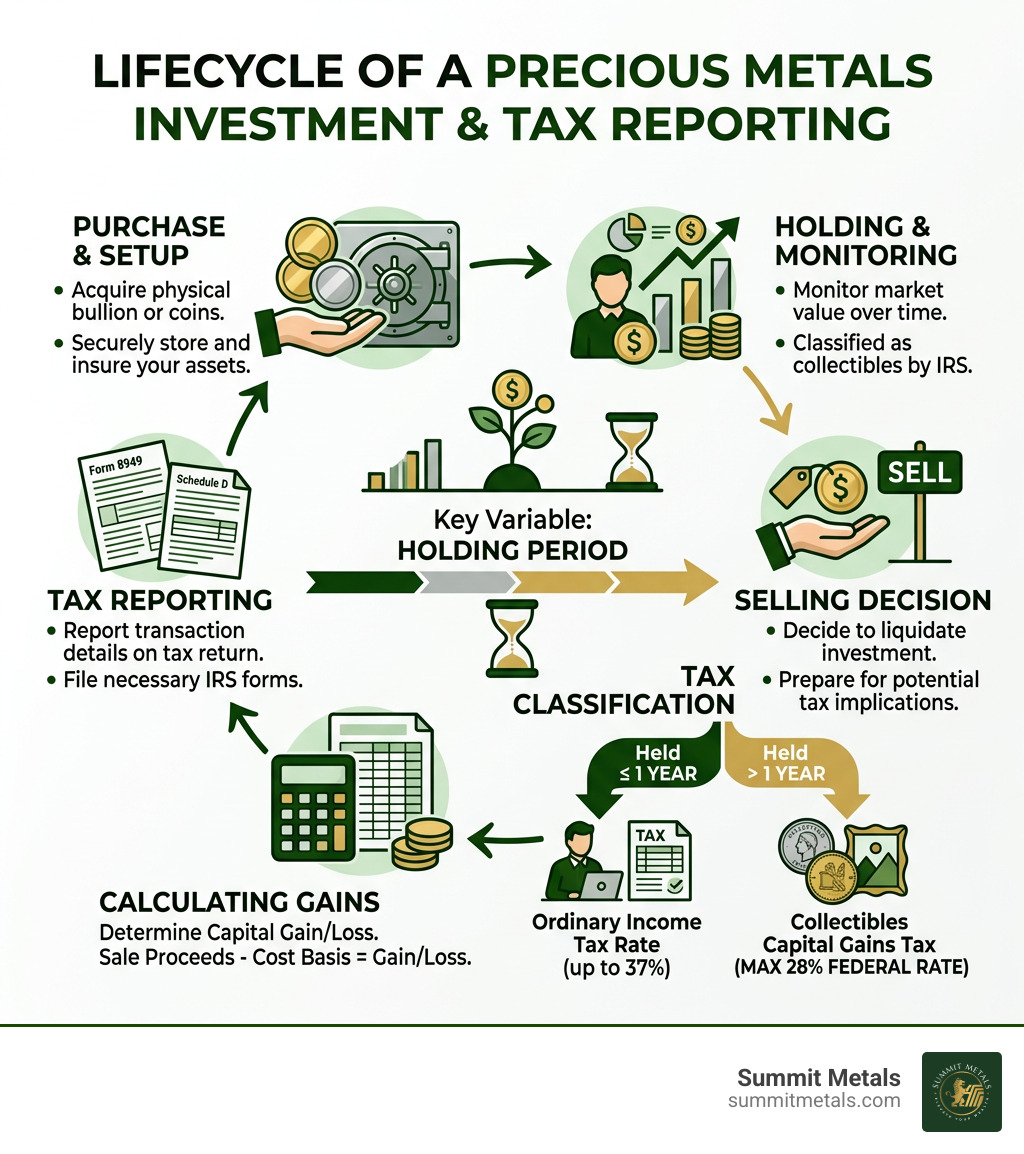
How the IRS Classifies Physical Precious Metals
When we talk about selling precious metals taxes, the first hurdle is understanding that the IRS doesn't see your silver coins the same way it sees your shares of a tech company. Under Internal Revenue Code Section 408(m), most physical precious metals held for investment are classified as "collectibles."
This classification includes:
- Physical bullion (coins and bars)
- Numismatic or rare coins
- Even certain precious metal ETFs that are organized as "grantor trusts" (because they hold the physical metal on your behalf)
Why does this matter? Because collectibles are denied the preferential long-term capital gains rates (0%, 15%, or 20%) that apply to stocks. Instead, they are hit with a higher ceiling. While they are still considered capital assets, they are "tangible wealth" in the eyes of the government, and the tax man wants a larger slice of that tangible pie.

Calculating Selling Precious Metals Taxes: Rates and Brackets
Calculating what you owe involves looking at two main factors: how long you held the metal and how much money you make overall.
For federal purposes, the maximum rate for long-term gains on collectibles is 28%. However, if you fall into a lower income tax bracket (like the 10%, 12%, or 22% brackets), you may pay your ordinary income rate on those gains instead. The 28% is a cap, not a flat fee.
There is also the "hidden" tax: the Net Investment Income Tax (NIIT). If you are a high-income taxpayer with a modified adjusted gross income (MAGI) over $200,000 single or $250,000 married filing jointly, you may owe an additional 3.8% surtax on your gains.
Short-Term vs. Long-Term Selling Precious Metals Taxes
The "one-year rule" is the most critical deadline in your investment journey.
- Short-Term (Held 1 year or less): Your profit is added to your regular income and taxed at your ordinary income rate, which can go as high as 37%.
- Long-Term (Held more than 1 year): Your profit is taxed at the collectibles rate, capped at 28%.
If you’re sitting on a massive gain from the 2025 surge (remember, gold gained 65% that year!), waiting for that 366th day of ownership could save you a significant amount in taxes if you are in a high ordinary income bracket.
Reporting Requirements and Selling Precious Metals Taxes Forms
Don't wait for the IRS to send you a letter. It is your responsibility to report these sales.
- Form 8949: This is where you list the details of the sale—what you sold, when you bought it, and your cost basis.
- Schedule D: You’ll carry the totals from Form 8949 over to Schedule D of your Form 1040.
- Form 1099-B: In some cases, the dealer you sell to is required to report the transaction to the IRS. For example, selling more than 25 one-ounce Gold Krugerrands or 1,000 troy ounces of silver bars typically triggers this requirement.
Even if you don't receive a 1099-B, you are legally required to report the gain. At Summit Metals, we always recommend keeping meticulous records of your purchase invoices to substantiate your cost basis.
Determining Your Cost Basis: Gifts, Inheritances, and Purchases
Your "cost basis" is simply what you paid for the metal, plus any associated costs like shipping, insurance, or dealer premiums. But things get tricky when you didn't buy the metal yourself.
Inherited Metals: The "Step-Up" Win
If you inherited a coin collection, you likely received a "step-up in basis." This means your cost basis is the fair market value of the metal on the date of the original owner’s death, not what they originally paid for it. If your grandfather bought gold at $400 and it was worth $2,300 when he passed, your basis is $2,300. If you sell it for $2,300 immediately, you owe $0 in taxes.
Gifted Metals: The Donor's Shadow
Gifts are less tax-friendly. If someone gifts you gold, you generally inherit their original purchase price as your basis. If they bought it cheap years ago, you'll be on the hook for a massive tax bill when you sell.
The Specific Identification Method
If you’ve bought gold at different prices over the years, the IRS allows you to choose which specific coins you are selling. This is called the "Specific Identification Method."
- Pro Tip: To minimize selling precious metals taxes, sell your highest-cost coins first. By selling the coins you bought at peak prices, your "gain" is smaller, and your tax bill shrinks.
Strategic Tax Minimization and Exit Strategies
We want you to keep as much of your profit as possible. Beyond timing your sales, there are several advanced strategies to consider.
Tax-Loss Harvesting and the Wash Sale Loophole
One of the best-kept secrets in the metal world is that physical gold and silver are currently exempt from the "wash sale rule".
In the stock market, you can't sell a losing stock to claim a tax loss and then buy it right back. But with physical bullion, you can! If prices dip, you can sell your metal to "lock in" a capital loss (which can offset other gains), and then immediately repurchase the same amount of metal. This is a powerful way to use market volatility to your advantage.
Summit Metals Autoinvest: The DCA Advantage
One of the hardest parts of investing is "timing the market." This is why we created Summit Metals Autoinvest. It allows you to set up a dollar-cost averaging (DCA) subscription to buy precious metals every month, just like you would invest in a 401k. By buying a fixed dollar amount monthly, you naturally buy more when prices are low and less when they are high, smoothing out your cost basis over time and making your eventual tax calculation much simpler.
Exit Strategy: The "Sell to Us" Program
A great investment isn't just about the entry; it's about the exit. Many investors struggle to find liquid buyers when they are ready to cash out. Our "Sell to Us" program provides a guaranteed exit strategy. Whether you store your metals at home or in a private vault, we offer transparent, real-time pricing to ensure you can liquidate your assets quickly. When you're ready to sell, we make the process seamless, helping you document the sale for your tax records.
Precious Metals in IRAs: Exceptions to the Rule
Did you know some metals aren't taxed as collectibles? Under Internal Revenue Code Section 408(m)(3), certain U.S.-minted coins like the American Gold Eagle or American Silver Eagle can be held in a self-directed IRA.
- The Benefit: Gains inside the IRA grow tax-deferred.
- The Catch: You cannot take physical possession of these coins; they must be held by an approved trustee or custodian. If you take them home, the IRS treats the entire amount as a distribution, which could trigger immediate taxes and penalties.
State-Level Taxes and Physical Asset Comparisons
While we've focused on federal taxes, your local geography matters. Summit Metals operates in Wyoming and has locations in Salt Lake City, Utah—two of the most "gold-friendly" areas in the country.
- Utah: The state has recognized gold and silver as legal tender, which has paved the way for eliminating state capital gains taxes on precious metals.
- Wyoming: With no state income tax and a very friendly stance toward bullion, Wyoming remains a top-tier destination for precious metals storage and investment.
When deciding what to buy, consider the form of the metal. Many of our clients ask: "Should I buy coins or bars?"
Comparison: Gold Coins vs. Gold Bars
| Feature | Gold Coins (e.g., Eagles) | Gold Bars |
|---|---|---|
| Fraud Protection | High (Face value & legal tender status) | Moderate |
| Premiums | Usually higher due to minting costs | Usually lower (closer to spot) |
| Liquidity | Extremely high (recognized globally) | High |
| Fractional Sales | Very easy (1/10 oz, 1/4 oz options) | Harder with large bars |
| Legal Tender | Yes (protected by federal counterfeiting laws) | No |
We often recommend coins for newer investors because their status as legal tender provides an extra layer of security against fraud.
Frequently Asked Questions about Metal Taxes
Do I have to pay taxes immediately after selling gold?
No. You don't pay the tax the moment you walk out of the dealer's office. You report the gain on your annual tax return. However, if your gain is substantial, you might need to make estimated tax payments to avoid underpayment penalties.
Can I offset my gold gains with stock market losses?
Yes! Collectible gains are capital gains. If you lost $5,000 in the stock market this year but made $5,000 selling silver, they can offset each other, potentially bringing your tax liability for those transactions to zero.
Are American Eagle coins exempt from the 28% collectibles tax?
This is a common myth. While they are "legal tender," the IRS still classifies them as collectibles for capital gains purposes when held outside of an IRA. The only way to bypass the 28% rate is by holding them within a qualifying retirement account or by being in a lower overall income tax bracket.
Conclusion
Navigating selling precious metals taxes doesn't have to be a nightmare. By understanding your cost basis, timing your sales for the long-term threshold, and utilizing strategies like tax-loss harvesting, you can protect your wealth from unnecessary erosion.
At Summit Metals, we are committed to more than just a transaction. Whether you are using our Autoinvest program to build your legacy or our Sell to Us program to fund your retirement, we provide the transparent pricing and bulk-purchasing value you need to succeed.
For more deep dives into tax-efficient strategies, check out our practical guide to selling gold and silver tax-free.
Ready to start your journey or plan your exit? Visit us in Salt Lake City or reach out to our Wyoming headquarters today. Prices shown are at the time of this publication.


