

What Is the Live Spot Gold Price Right Now?

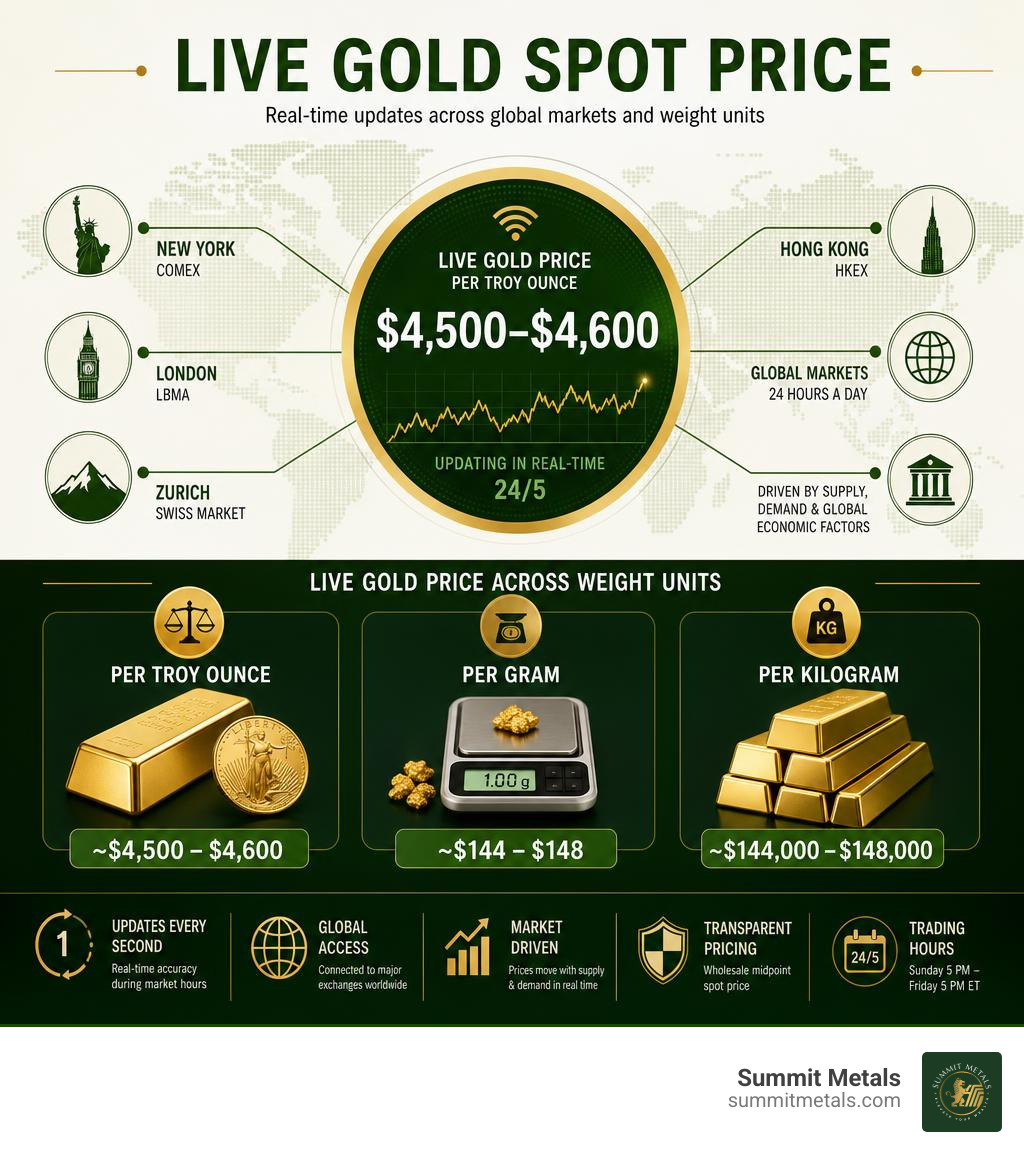
The live spot gold price is the real-time market price for one troy ounce of gold available for immediate delivery. It changes constantly during trading hours — every second, based on global supply and demand.
Here's a quick snapshot of gold pricing across common weight units (prices shown are at the time of this publication):
| Weight Unit | Approximate Price (USD) |
|---|---|
| Per Troy Ounce | ~$4,500–$4,600 |
| Per Gram | ~$144–$148 |
| Per Kilogram | ~$144,000–$148,000 |
Key facts at a glance:
- Gold trades 24 hours a day, Sunday through Friday, across exchanges in New York, London, Zurich, and Hong Kong
- The spot price reflects the wholesale midpoint — not the price you'll pay at a dealer
- Gold hit an all-time high of $5,602.22 per troy ounce on January 28, 2026
- Since 1971, gold has averaged an annual return of approximately 7.78%
- Prices update in real-time during market hours and shift based on inflation, interest rates, geopolitical events, and central bank activity
Whether you're tracking the market daily or considering your first purchase, understanding how the spot price works is the foundation of smart gold investing.
I'm Eric Roach — a former Wall Street investment banker and M&A advisor who has spent over a decade helping clients use gold as a strategic hedge against market volatility, and I rely on the live spot gold price every day to guide precise, well-timed investment decisions. Let's break down exactly how this market works and what it means for your portfolio.
Explore more about live spot gold price:
Understanding the Live Spot Gold Price and How It Is Set
To navigate the precious metals market successfully, we must first pull back the curtain on how the live spot gold price is calculated. It isn't magic, and it isn't decided by a single person in a dark room. Instead, it is the product of a massive, highly coordinated global network of buyers and sellers trading 24 hours a day.
The foundation of the live spot price rests on two major pillars: the futures markets and the physical Over-the-Counter (OTC) markets.
The primary driver of the real-time price you see on your screen is the Commodities Exchange (COMEX) in New York. On the COMEX, traders buy and sell gold futures contracts. The spot price is derived directly from these contracts, specifically using the nearest active month with the highest trading volume. Because these contracts trade nearly around the clock, they provide a continuous stream of price updates.
Simultaneously, the physical wholesale market operates as an Over-the-Counter (OTC) network. This means trades are conducted directly between two parties (such as major bullion banks, central banks, and institutional investors) rather than on a centralized exchange floor. This global relay race begins in Sydney, moves through Tokyo and Hong Kong, transitions to London and Zurich, and finally crosses the Atlantic to New York before starting all over again.
As these institutions trade massive blocks of gold (often between 5,000 and 10,000 ounces at a time), their transactions establish the market midpoint. If you want to watch these fluctuations yourself as they happen, you can Track real-time market movements to see how global events instantly register on the charts.
How the Live Spot Gold Price Differs from the LBMA Daily Fix
While the spot price flickers and changes every second, institutional markets also rely on a more stable yardstick: the LBMA Gold Price, historically known as the London Gold Fix.
Dating back to 1919, the London Fix was designed to establish a single benchmark price for the industry. Today, this process is managed electronically by the London Bullion Market Association (LBMA) via twice-daily auctions at 10:30 AM and 3:00 PM London time.
During these auctions, major market-making bullion banks submit buy and sell orders. The price is adjusted in rounds until the supply of gold matches the demand. Once this equilibrium is reached, the official LBMA Daily Fix is published.
The key differences between the two are simple:
- The Live Spot Price is continuous, highly volatile, and reflects immediate retail and futures market sentiment.
- The LBMA Daily Fix is a static benchmark used by mining companies, central banks, and large institutions to price massive physical contracts without worrying about second-by-second market noise.
Bid, Ask, and the Spread: The Mechanics of Gold Pricing
When you look at a live gold chart, you will notice three distinct figures: the bid price, the ask price, and the spread. Understanding these is crucial to avoiding rookie mistakes when buying or selling.
- The Bid Price: This is the maximum price a buyer (such as a dealer) is currently willing to pay for an ounce of gold. If you are looking to sell your gold, this is the benchmark price you will be offered.
- The Ask Price: This is the minimum price a seller (such as a dealer) is willing to accept for that same ounce of gold. If you are looking to buy, this is the starting point for the transaction.
- The Spread: This is the difference between the bid and ask prices.
The spread represents the transaction costs and the profit margin of the market makers. In highly liquid markets, the spread is incredibly narrow—often just a couple of dollars. However, when market volatility spikes or trading volume dries up, the spread can widen significantly.
Key Factors Influencing Today's Gold Market Forecast
As we look at the market landscape in May 2026, gold continues to prove why it is considered the ultimate financial shock absorber. The live spot gold price does not move in a vacuum; it responds dynamically to a delicate web of macroeconomic indicators.
- Inflation and Currency Devaluation: When fiat currencies lose their purchasing power, gold shines. Because gold has a finite supply, it acts as a store of value. As the purchasing power of paper money is eroded by inflation, investors flock to gold to preserve their hard-earned wealth.
- Interest Rates and Central Bank Policies: Gold has an inverse relationship with real interest rates. Because physical gold does not pay a dividend or yield interest, rising interest rates make yield-bearing assets (like government bonds) more attractive. Conversely, when central banks cut rates or signal monetary easing, the opportunity cost of holding gold drops, driving prices higher.
- Geopolitical Tension: Wars, trade disputes, and political instability create market anxiety. During times of crisis, investors seek "safe-haven" assets that carry no counterparty or contractual risk.
- Central Bank Accumulation: Governments around the world are among the largest holders of gold. In recent years, central banks have aggressively expanded their gold reserves to diversify away from foreign fiat currencies, creating a massive, consistent baseline of demand.
- US Dollar Strength: Because gold is internationally denominated in US Dollars (USD), a stronger dollar typically makes gold more expensive for foreign buyers using local currencies, which can temporarily cool global demand. When the dollar weakens, gold becomes cheaper globally, pushing the spot price upward.
To navigate these shifts, we always advise our clients in Salt Lake City and across Wyoming to monitor live gold charts closely to spot how these macroeconomic forces interact in real-time.
Historical Highs and Recent Trends Leading into 2026
To understand where the gold market is headed, we must look at where it has been. The journey of the last few years has been nothing short of historic.
- August 2020: Gold broke above $2,000 per ounce for the first time in history, driven by the global economic lockdowns and massive central bank stimulus during the COVID-19 pandemic.
- March 14, 2025: Amid rising economic anxiety and trade discussions surrounding tariffs on Canada and Mexico, gold prices surged to $3,004.71 per ounce.
- April 22, 2025: Following formal tariff announcements, gold set a new milestone, climbing to $3,500.20 per ounce.
- January 28, 2026: Gold achieved its current lifetime record, hitting an astonishing $5,602.22 per troy ounce as global geopolitical shifts and currency concerns reached a boiling point.
Over the long term, gold has proven to be an incredibly resilient asset. From 1971 (when the US abandoned the gold standard) through 2022, gold demonstrated an average annual rate of return of approximately 7.78%, outperforming many traditional fiat-based savings vehicles.
Currency Fluctuations: Gold in USD vs. GBP and EUR
Because gold is priced globally in US Dollars, currency fluctuations play a massive role in what international investors actually pay.
If the US Dollar strengthens while the British Pound (GBP) or Euro (EUR) weakens, gold can reach all-time highs in London or Frankfurt even if the USD spot price remains completely flat. This dynamic creates arbitrage opportunities for global FOREX traders who buy and sell gold across different currency pairs to exploit minor pricing inefficiencies.
For local investors in Wyoming and Utah, tracking the USD-denominated spot price remains the primary focus, but keeping an eye on global currency health provides valuable context for where the market is headed next.
Physical Gold Investment: Premiums, Coins, and Bars
If you have ever tried to buy physical precious metals, you quickly realize you cannot buy gold at the exact spot price. Why? Because the spot price represents raw, unprocessed virtual gold. To own the physical asset, you must account for "premiums."
A premium is the additional cost added to the spot price of gold to cover physical fabrication, minting, distribution, insurance, and the dealer's operating margin.
When choosing physical gold, investors generally choose between gold coins and gold bars. To help you make an informed decision for your portfolio, we have put together a comparison chart detailing the key differences:
| Feature | Gold Coins | Gold Bars |
|---|---|---|
| Sovereign Backing | Yes (issued by government mints) | No (issued by private refiners) |
| Legal Tender / Face Value | Yes (provides official fraud protection) | No |
| Manufacturing Premiums | Slightly higher due to intricate designs | Lower due to simpler manufacturing |
| Liquidity | Extremely high (universally recognized) | High, but may require assaying |
| Counterfeit Protection | Advanced security features from national mints | Standard security features (assay cards) |
Gold Coins vs. Gold Bars: Protecting Your Wealth
While gold bars offer a cost-effective way to acquire pure weight at a lower premium, we often recommend that retail investors prioritize gold coins.
Gold coins are minted by sovereign governments (such as the US Mint) and carry a legal tender face value. This face value is incredibly important: because they are official currency, counterfeiting a sovereign gold coin carries severe federal mail fraud and counterfeiting penalties. This legal protection, combined with advanced security engravings, makes gold coins highly trusted, incredibly easy to authenticate, and exceptionally liquid when it comes time to sell.
Smart Buying Strategies: Dollar-Cost Averaging and Autoinvest
Trying to time the perfect market entry can be stressful, exhausting, and—frankly—often leads to buying at the wrong time. That is why we advocate for a smarter, hands-off approach: dollar-cost averaging (DCA).
Think of dollar-cost averaging just like contributing to your employer-sponsored 401(k). Instead of trying to guess when gold has hit its absolute floor, you invest a fixed dollar amount at regular, scheduled intervals (such as every month).
- When the live spot gold price is low, your fixed dollar amount buys more gold.
- When the price is high, your fixed dollar amount buys less gold.
Over time, this strategy averages out your purchase price, taking the emotional guesswork out of investing. To help our clients build long-term wealth without the stress, we offer a specialized monthly program. You can Learn more about dollar-cost averaging to see how it protects your purchasing power, and when you are ready to automate your wealth building, you can Set up automated gold purchases through our secure system.
Planning Your Exit Strategy: Storage and Selling Your Gold
A complete investment plan must include a clear exit strategy. Buying gold is only half the battle; you must also consider where you will keep it safe and how you will liquidate it when the time comes.
While keeping gold in a home safe is popular, it comes with significant security and insurance risks. For true peace of mind, many investors turn to professional, third-party private depositories.

Storing your assets in a secure, fully insured private vault facility in Wyoming or Utah ensures your metals are protected by military-grade security. More importantly, professional storage keeps your investment highly liquid. Because the gold remains within a continuous "chain of custody" inside an approved depository, dealers can verify its authenticity instantly, allowing you to sell your gold in minutes without waiting for shipping or costly re-assaying.
How to Sell Your Gold Near the Live Spot Gold Price
When you are ready to lock in your profits, you want a dealer that offers transparent, real-time pricing and a straightforward liquidation process.
To get the best possible price, avoid pawn shops or "we buy gold" kiosks, which typically offer pennies on the dollar. Instead, work with an established precious metals firm that locks in your sale price based on the current live spot market.
At Summit Metals, we focus on helping you through every stage of your investment journey—including your exit. If you are ready to liquidate your holdings safely and efficiently, you can Sell your gold bullion to us for competitive, transparent market rates.
Frequently Asked Questions About Gold Prices
What is the current live spot price of gold per ounce, gram, and kilogram?
The live spot price is quoted per troy ounce in US Dollars. Because the market moves second-by-second, the exact price fluctuates constantly. To find the price of smaller or larger weights, the troy ounce price is mathematically converted:
- Per Gram: The troy ounce price divided by 31.1035.
- Per Kilogram: The troy ounce price multiplied by 32.1507.
Why can't investors buy physical gold at the exact spot price?
The spot price represents "paper" or wholesale digital gold trading in massive quantities. To turn that digital price into a physical coin or bar in your hand, it must be refined, minted, assayed, packaged, insured, and shipped. The premium charged by dealers covers these real-world fabrication and distribution costs.
How can I track or receive alerts for changes in the live gold price?
Most reputable precious metals websites and financial tracking apps allow you to set custom price alerts. You can configure these tools to send an email or push notification straight to your phone when gold crosses a specific price threshold, helping you stay informed of sudden market volatility.
Conclusion
Navigating the precious metals market does not have to be intimidating. By understanding how the live spot gold price is set, accounting for premiums, and choosing the right products, you can build a resilient, tangible portfolio that stands the test of time.
At Summit Metals, based in Wyoming, we are dedicated to providing investors in Salt Lake City, Utah, and throughout the region with transparent, real-time pricing and highly competitive rates. Through our bulk purchasing power, we ensure you get the absolute best value for your hard-earned money.

Whether you want to make a one-time purchase or build your wealth steadily over time, we are here to help. Explore Summit Metals subscriptions today to start your automated gold savings plan and secure your financial future.


