

Gold ETFs Come With More Risks Than Most Investors Realize

The disadvantages of investing in gold ETF products are often overlooked by investors who assume they're getting the same protection as physical gold. They're not.
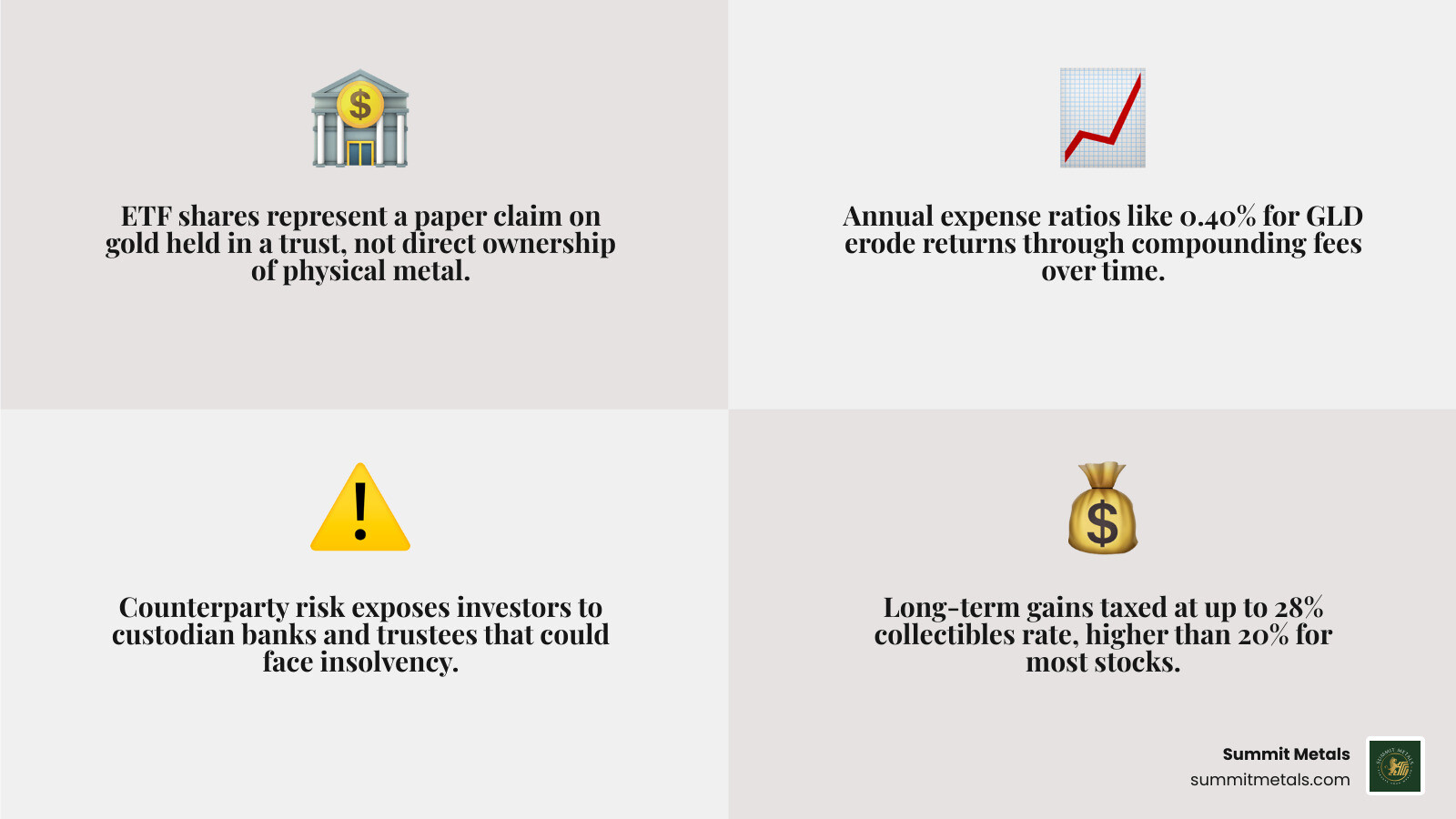
Here's a quick summary of the key risks:
| Disadvantage | What It Means for You |
|---|---|
| No physical ownership | You hold a paper claim, not real gold |
| Ongoing expense ratios | GLD charges 0.40%/yr; IAU charges 0.25%/yr — fees compound silently |
| Counterparty risk | You depend on banks, trustees, and custodians to hold your gold |
| Collectibles tax rate | Long-term gains taxed up to 28%, vs. 20% for most stocks |
| Liquidity risk | Trading halts and SEC issues can block access to your investment |
| No inflation of premiums | During supply crunches, ETF holders miss the price premiums physical holders capture |
Gold ETFs trade like stocks and track gold prices — but that convenience comes with a hidden set of risks most investors don't read about until it's too late.
Gold has averaged around 8.30% per year since 1971. But owning a claim on gold and owning gold itself are two very different things. In 2016, iShares Gold Trust couldn't issue new shares to investors after failing to register with the SEC — a stark reminder that these products carry real structural vulnerabilities.
I'm Eric Roach, a former investment-banking and M&A advisor who has guided clients through multi-billion-dollar transactions on Wall Street. Today, I help everyday investors understand the disadvantages of investing in gold ETF structures — and why physical precious metals often offer a more resilient path to wealth preservation. Let's dig into what the fine print on these products actually says.
The Illusion of Ownership: Why You Don't Actually Own Gold
When you buy a share of a gold ETF, you might picture a specific gold bar sitting in a vault with your name on it. Unfortunately, that’s not how the plumbing of the financial system works. As George Milling-Stanley, the founder of the SPDR Gold Trust (GLD), famously put it: "When you buy GLD shares, you're buying an ownership in a trust... The individual [buyer] does not own gold that backs the trust, any more than an investor in GM owns a car or an investor in Apple owns an iPhone."
In other words, you own a paper proxy. You have a claim on a trust that holds gold, but you don't have a direct legal title to the metal itself. This is one of the most significant disadvantages of investing in gold ETF funds. If you want to understand the granular details of how these "paper" claims differ from the real thing, check out our guide on What’s the Difference Between Physical Gold/Silver and ETFs?.
The most frustrating part for many retail investors is the delivery restriction. Most major gold ETFs explicitly state in their prospectus that they have no obligation to provide physical gold to individual shareholders. To even request an exchange for physical bars from a fund like GLD, you typically need to own a minimum of 100,000 shares. At recent prices, that’s an investment of roughly $12 million. Even then, you’d receive 400-ounce "Good Delivery" bars that are nearly impossible for an individual to store or sell without massive logistical headaches. For the average investor, physical redemption is a mathematical impossibility.

Hidden Costs and the Disadvantages of Investing in Gold ETF Returns
Many investors choose ETFs because they seem "cheap." While you don't have to pay for a home safe or a private vault upfront, the ongoing fees can quietly cannibalize your returns over decades. This process is known as Net Asset Value (NAV) erosion.
Every year, the ETF sells a small portion of its gold holdings to pay for management fees, marketing, and custodial costs. This means that over time, each share you own represents less and less actual gold. For example, a share of iShares Gold Trust (IAU) that used to represent a certain fraction of an ounce has dwindled to about 0.019 ounces as of late 2024 because of these compounding fees.
| Feature | Gold ETF (e.g., GLD/IAU) | Physical Gold (Summit Metals) |
|---|---|---|
| Annual Expense Ratio | 0.25% to 0.40%+ | 0.00% |
| Storage Fees | Built into share price (erodes gold) | Varies (often lower than ETF fees) |
| Transaction Costs | Brokerage commissions + Bid-Ask spread | One-time premium |
| Tracking Error | High risk during market stress | Moves 1:1 with market value |
These expense ratios might look small—0.40% for GLD or 0.25% for IAU—but when compounded over 20 or 30 years, they create a massive performance gap. Furthermore, ETFs often suffer from "tracking error," where the share price deviates from the actual spot price of gold due to fund expenses or market volatility. For a deeper dive into the math of these costs, see our article on Physical Bullion vs Gold & Silver ETFs: Pros and Cons.
Counterparty Risk: Trusting the Shaky Banking System
One of the primary reasons people buy gold is to protect themselves against a failure in the banking system. However, when you buy a gold ETF, you are staying firmly inside that very system. This introduces "counterparty risk"—the danger that one of the institutions involved in the ETF might fail to fulfill its obligations.
Gold ETFs involve a complex chain of custody:
- The Trustee: Oversees the fund.
- The Custodian: Usually a major bank (like HSBC or JPMorgan) that stores the gold.
- Sub-Custodians: Other banks used by the primary custodian to hold overflow gold.
- Authorized Participants: Large institutions that create and redeem shares.
If any link in this chain breaks, your investment is at risk. History gives us plenty of reasons to be cautious. For example, HSBC—the custodian for GLD—has been fined billions of dollars for money laundering and foreign exchange manipulation in the past. If a custodian faces a systemic crisis or insolvency, ETF shareholders are often treated as unsecured creditors. You are effectively betting that the bank will always be there to honor your paper claim. In a true financial meltdown, that is a risky bet to make.
Tax and Structural Pitfalls of Paper Gold
There is a common misconception that gold ETFs are taxed like stocks. They aren't. Because the IRS views these funds as "grantor trusts" that hold physical metal, they are subject to the same tax rules as physical gold.
Tax Disadvantages of Investing in Gold ETF Holdings
If you hold a gold ETF for more than a year, your gains are taxed at the "collectibles" rate, which tops out at 28%. Compare that to traditional stocks or stock ETFs, where the long-term capital gains rate is usually capped at 15% or 20%.
Think about the math: if you make a $10,000 profit on a tech stock, you might pay $1,500 in taxes. If you make that same $10,000 profit on a gold ETF, you could owe $2,800. That 13% difference is a direct hit to your net wealth, and it’s one of the most overlooked disadvantages of investing in gold ETF products. Additionally, the fund itself may sell gold to pay expenses, which can trigger "taxable events" for you even if you haven't sold a single share.
Structural Disadvantages of Investing in Gold ETF Liquidity
While ETFs are marketed as "liquid," that liquidity only exists as long as the stock exchange is open and the fund is functioning correctly. In 2016, the iShares Gold Trust (IAU) actually failed to register enough new shares with the SEC, forcing them to temporarily halt the creation of new shares. This administrative error meant the ETF couldn't track the price of gold accurately for a period, leaving investors in the lurch.
During times of extreme market stress, bid-ask spreads (the difference between what you can buy and sell for) often widen significantly. While physical gold often gains a "scarcity premium" during a crisis, paper gold ETFs can actually trade at a discount to the price of the gold they are supposed to represent.
Better Alternatives: Physical Bullion and Autoinvest Strategies
At Summit Metals, based in Wyoming, we believe there is simply no substitute for the security of physical ownership. We provide authenticated gold and silver with transparent, real-time pricing. Because we purchase in bulk, we can offer competitive rates that ensure you get the most value for your dollar.
If you like the "set it and forget it" nature of an ETF, we have a better solution: Autoinvest. This allows you to dollar-cost average into physical gold or silver every month, just like you would with a 401(k) or IRA. It removes the stress of timing the market while ensuring you are building a stash of real, tangible wealth.
Comparison: Gold Coins vs. Gold Bars
When choosing physical metal, it's important to understand the difference between coins and bars.
| Feature | Gold Coins (Sovereign Minted) | Gold Bars (Private Mint) |
|---|---|---|
| Face Value | Yes (Legal Tender) | No |
| Fraud Protection | Higher (Government backed) | Standard (Assay card) |
| Premiums | Slightly higher | Lower |
| Recognition | Instant global recognition | Requires assay/testing |
We often recommend gold coins for newer investors because their status as legal tender provides an extra layer of protection against fraud.
Finally, consider your exit strategy. One of the biggest fears investors have about physical gold is how to sell it. We offer a "Sell to us" program that makes liquidation simple. If you store your metals in a private, secure vault through our partners, your holdings remain highly liquid. You can sell back to us instantly at current market rates, giving you the best of both worlds: the security of physical gold and the speed of a digital transaction. To learn more about starting your journey, visit our page on buying gold.
Frequently Asked Questions about Gold ETFs
Can I trade my ETF shares for physical gold bars?
For 99% of investors, the answer is no. Major ETFs like GLD require a minimum of 100,000 shares (worth millions of dollars) to even request a physical redemption. Even then, the fund reserves the right to pay you in cash instead of gold.
What is the biggest disadvantage of investing in gold ETF?
The biggest disadvantage is the lack of true ownership. You are holding a paper contract that is dependent on the stability of the banking system, rather than a tangible asset that has no counterparty risk.
Are gold ETFs safer than physical gold during a financial crisis?
Actually, the opposite is often true. During a systemic banking crisis, ETFs are vulnerable to trading halts, fund liquidations, and custodian insolvency. Physical gold held outside the banking system is one of the few assets that remains entirely under your control when the digital markets fail.
Conclusion
The disadvantages of investing in gold ETF structures become most apparent exactly when you need gold the most—during times of economic uncertainty and institutional distrust. While ETFs offer convenience for short-term traders, they fail to provide the tangible security and wealth preservation that has made gold the ultimate safe haven for centuries.
Don't settle for a paper promise. By choosing physical bullion and utilizing strategies like Autoinvest, you can build a legacy of real wealth that isn't dependent on the "management prowess" of a distant bank. Start your physical gold journey with Summit Metals today and experience the peace of mind that comes with owning the real thing.


