

Introduction: Open uping the Hidden Value in Your Old Coins
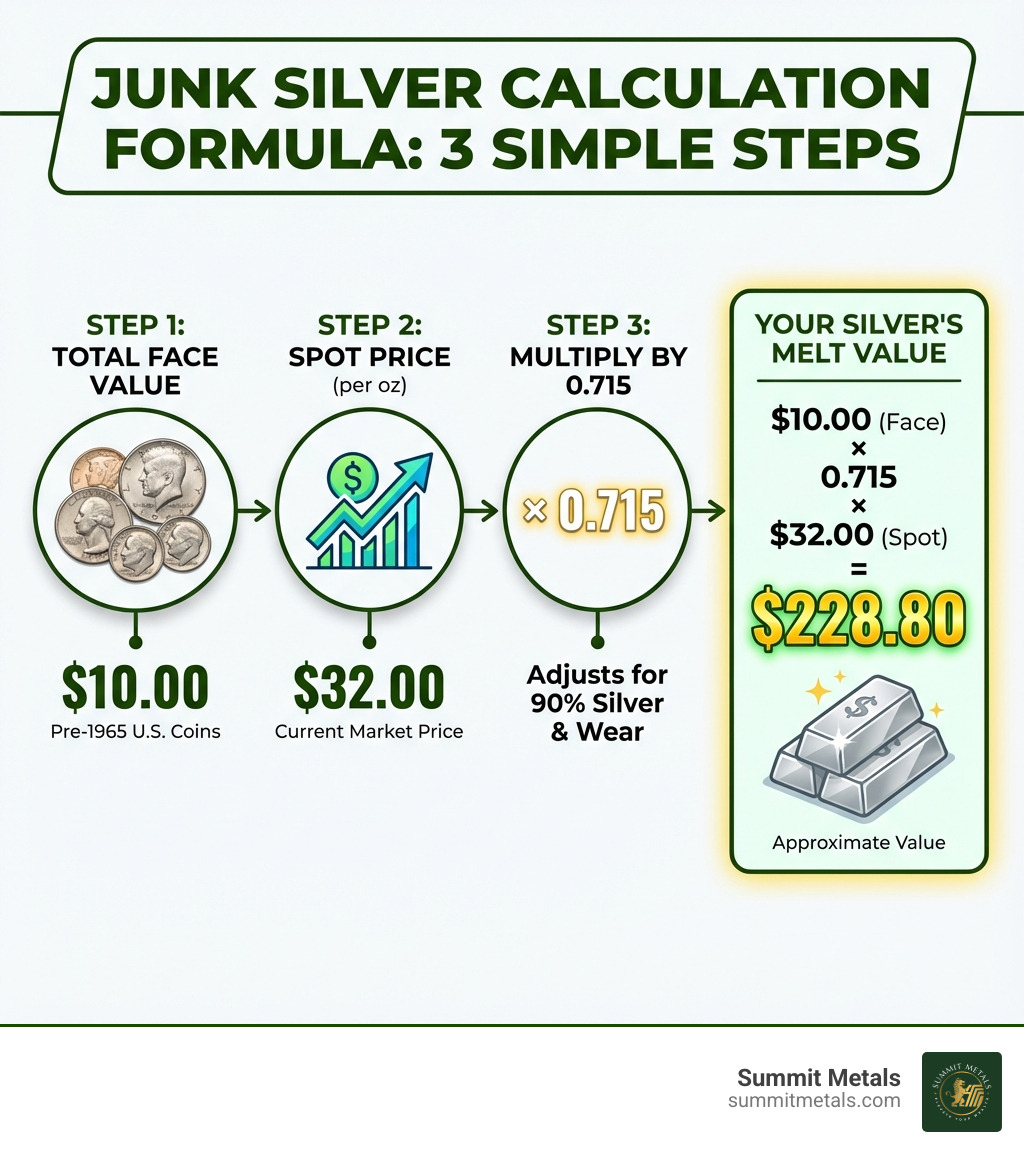
Calculating silver in junk silver is straightforward once you know the formula. Here's the quick answer:
The 3-Step Formula:
- Add up the total face value of your pre-1965 dimes, quarters, and half dollars
- Find the current silver spot price per troy ounce (check financial sites like Nasdaq)
- Multiply: Face Value × 0.715 × Spot Price = Your Silver's Melt Value
Example: $10 face value × 0.715 × $32 spot price = $228.80 in silver
That jar of old quarters in your attic? Those worn dimes your grandfather collected? They're not just pocket change—they're a tangible store of wealth that has quietly protected savings for generations. Pre-1965 U.S. coins contain 90% silver, and with silver prices climbing, many people find their "junk silver" is worth eight times its face value or more.
The challenge is knowing exactly how much silver you own. Unlike modern bullion rounds stamped ".999 Fine Silver," these circulated coins show decades of wear. Their weight varies. Their silver content isn't obvious. And if you've ever tried explaining troy ounces to someone unfamiliar with precious metals, you know the math can feel tedious.
That's why we built this guide—to give you a clear, repeatable system for valuing any pile of junk silver in minutes. Whether you inherited a coin collection, stumbled across old coins at an estate sale, or are building a position to hedge against inflation, you need to know what you're holding.
What Exactly is "Junk Silver"?
When we talk about "junk silver," we're not implying these coins are worthless. Quite the opposite! The term "junk silver" simply refers to U.S. coins minted before 1965 that contain 90% silver and 10% copper. These coins are typically circulated, meaning they've seen a lot of pockets, cash registers, and hands, resulting in wear and tear. Because of this, their value is primarily derived from their silver content, rather than any numismatic (collector) appeal. Most circulated pre-1965 silver coins have no numismatic value above their silver content.
The common denominations you'll find in the "junk silver" category include:
- Roosevelt Dimes (1946-1964)
- Mercury Dimes (1916-1945)
- Washington Quarters (1932-1964)
- Kennedy Half Dollars (1964 only)
- Franklin Half Dollars (1948-1963)
- Walking Liberty Half Dollars (1916-1947)
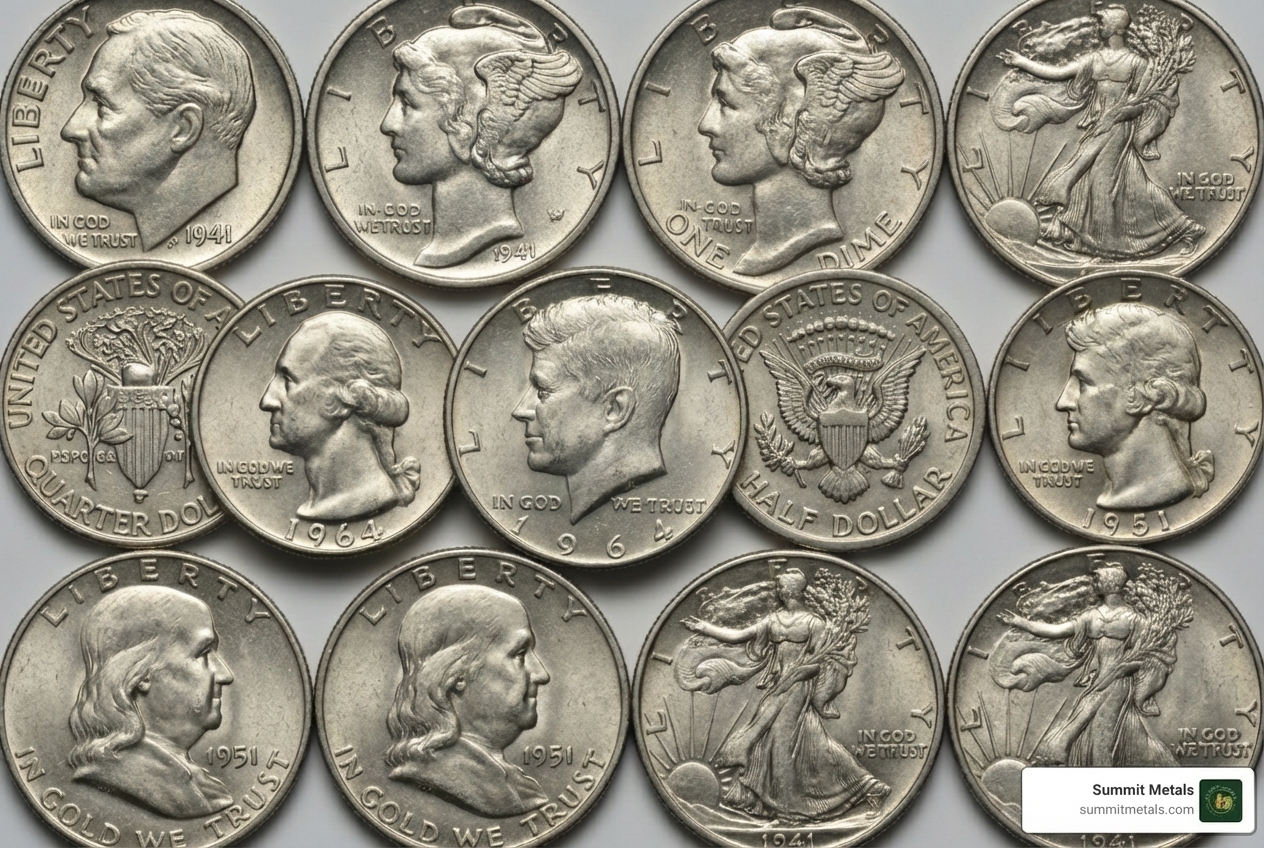
Historically, much of the USA's circulating coinage had this 90% silver content. For example, all 25¢ quarters issued in 1964 and prior had 6.25 grams or almost 1/5th an ounce of silver in each. Today's U.S. Mint quarters, in stark contrast, are struck using low-value pot metal alloys of copper and nickel, containing no silver at all.
Exceptions to the Rule: Not All Old Coins are 90% Silver!
While the 90% rule covers most pre-1965 U.S. dimes, quarters, and half dollars, there are a couple of important exceptions you should know about when calculating silver in junk silver:
- War Nickels (1942-1945): During World War II, nickel was a critical war material. To conserve it, the U.S. Mint changed the composition of nickels to 35% silver, 56% copper, and 9% manganese. These coins are easily identifiable by a large mint mark (P, D, or S) located above the dome of Monticello on the reverse side.
- 40% Silver Half Dollars (1965-1970): The Kennedy Half Dollar, introduced in 1964 as 90% silver, saw a change immediately after. From 1965 to 1970, these half dollars contained 40% silver. Their outer layer was 80% silver and 20% copper, while the core was 21.5% silver and 78.5% copper. Each of these specific coins contains 0.1479 troy ounces of silver.
Historical Context: Why the Change?
The shift away from silver coinage wasn't arbitrary. The U.S. dollar's value was historically tied to a specific weight and purity of silver bullion, as defined by the 1792 Coinage Act. However, as the price of silver began to rise significantly in the mid-20th century, the intrinsic value of the silver in coins started to exceed their face value. People began hoarding silver coins, removing them from circulation, a phenomenon known as Gresham's Law ("bad money drives out good").
To prevent this and keep coins in circulation, the U.S. government enacted The Coinage Act of 1965. This pivotal act eliminated silver from all circulating dimes and quarter-dollar coins, and reduced the silver content in half dollars to 40% for a few years before eliminating it entirely. This move ensured that the cost to mint a coin wouldn't exceed its face value, but it also marked the end of an era for everyday silver coinage.
The Simple Formula for Calculating Silver in Junk Silver
Now that we know what junk silver is, let's dive into the practical steps for valuing your stash. This core method is what most dealers and investors use, and it's surprisingly simple once you get the hang of it.
Step 1: Sum the Total Face Value
The first step in calculating silver in junk silver is to count your coins and determine their total face value. This means treating them as if they were still just regular currency.
- Dimes: Each dime ($0.10)
- Quarters: Each quarter ($0.25)
- Half Dollars: Each half dollar ($0.50)
Simply separate your coins by denomination and add up their total face value. For example, if you have 10 dimes, 4 quarters, and 2 half dollars:
- 10 dimes x $0.10 = $1.00
- 4 quarters x $0.25 = $1.00
- 2 half dollars x $0.50 = $1.00
- Total Face Value = $3.00
It's common for junk silver to be sold or discussed in terms of "dollars of face value." A "bag of $1000 face value" would mean 10,000 dimes, or 4,000 quarters, or 2,000 half dollars, or any combination that adds up to $1,000.
Step 2: Find the Current Silver Spot Price
The "spot price" of silver is the current market price for one troy ounce of silver for immediate delivery. This price fluctuates constantly based on global supply and demand, economic news, and geopolitical events. It's the baseline value for all silver products.
What is a Troy Ounce? For precious metals like silver, gold, and platinum, weight is traditionally measured in troy ounces. This is important because a troy ounce is slightly heavier than a standard (avoirdupois) ounce that you might use for groceries.
- 1 troy ounce = approximately 31.103 grams
- 1 troy ounce = approximately 1.097 avoirdupois ounces
Where to Find Live Prices: You can find the current spot price of silver online through reputable financial news websites. We always recommend checking sources like Nasdaq or other major financial data providers for the most up-to-date information. Prices shown are at the time of this publication.
Step 3: Use the Magic Multiplier to Find Your Melt Value
This is where the "secret formula" comes into play for calculating silver in junk silver. When these coins were originally minted, a dollar's worth of 90% silver coins (e.g., four quarters, ten dimes, or two half dollars) contained 0.723 troy ounces of silver. However, because these coins circulated for years—sometimes decades—they experienced wear and tear, losing a small amount of their metal content.
To account for this average circulation wear, silver dealers universally use a slightly adjusted figure: 0.715 troy ounces of pure silver per dollar of face value for circulated 90% silver coins. This 0.715 multiplier already factors in an average of about 1.16% wear.
Here's the core formula for calculating silver in junk silver:
Melt Value = Total Face Value × 0.715 × Current Silver Spot Price

Let's walk through an example:
Imagine you have a bag of pre-1965 U.S. coins with a total face value of $50. The current silver spot price is $29.84 per troy ounce (Prices shown are at the time of this publication).
- Total Face Value: $50
- Silver Spot Price: $29.84
- Multiplier: 0.715
Melt Value = $50 × 0.715 × $29.84 Melt Value = 35.75 troy ounces × $29.84 Melt Value = $1,066.82
So, your $50 face value in junk silver would have a melt value of approximately $1,066.82. That's significantly more than $50!
We champion transparency and want you to have the tools to make informed decisions. By mastering the formula above, you can calculate the value of your holdings at any time. While many online calculators exist, understanding the underlying math empowers you to verify any calculation and become a more confident investor.
Advanced Considerations: Weight, Premiums, and Numismatic Value
While the simple formula is excellent for general valuation, understanding a few advanced considerations can help you fine-tune your estimates and avoid common pitfalls when calculating silver in junk silver.
A Deeper Look at Calculating Silver in Junk Silver by Weight
The 0.715 multiplier is a fantastic shortcut for U.S. 90% junk silver based on face value. However, there are scenarios where you might need to calculate based on actual weight:
- Non-U.S. Silver Coins: If you have foreign silver coins, their silver content and purity will vary. You'll need to know their total weight and silver purity percentage.
- Scrap Silver (Jewelry, Flatware): For items like old sterling silver jewelry or flatware, you'll definitely need to use weight.
- Very Worn or Damaged Coins: If your coins are excessively worn, damaged, or even cut, their actual silver content might be less than the 0.715 average. Weighing them can provide a more accurate melt value.
- Pre-1936 Silver Dollars: These coins contain more silver per dollar of face value, so the multiplier for these specific coins is 0.769 rather than 0.715.
The Formula for Calculating by Weight:
To calculate the melt value of silver based on its total weight and known purity:
Melt Value = Total Weight (in troy ounces) × Silver Purity (%) × Current Silver Spot Price
Let's look at common purities for scrap silver:
- Sterling Silver: Traditionally 92.5% (0.925) pure silver. You might find this in old silverware, jewelry, or decorative items.
- Fine Silver: 99.9% (0.999) pure silver. This is typically found in modern bullion bars, rounds, and some very high-purity jewelry.
Example for Sterling Silver: You have a sterling silver necklace weighing 2 troy ounces. The current spot price of silver is $29.84.
Melt Value = 2 troy oz × 0.925 × $29.84 Melt Value = 1.85 troy oz (pure silver) × $29.84 Melt Value = $55.10
Understanding Premiums and Total Cost
The "melt value" we've been calculating silver in junk silver for is the intrinsic value of the silver itself. However, when you buy or sell physical silver, you'll often encounter something called a "premium."
What is a Premium? A premium is the amount paid above the current spot price for a precious metal item. It covers the costs of minting, fabrication, distribution, dealer overhead, and profit. Think of it as the cost of doing business and acquiring a convenient, recognizable form of silver.
Factors Influencing Premiums:
- Market Demand: High demand can drive premiums up.
- Dealer Fees: Different dealers have different operating costs and profit margins.
- Coin Form: Junk silver often trades at a lower premium than pure silver rounds or bars due to its lower purity and circulated condition. However, within junk silver, some forms (like rolls of dimes) might have slightly different premiums than bulk bags.
- Rarity/Collectibility: Even within junk silver, certain dates or mint marks might command a small premium above melt, though this quickly transitions into numismatic value.
Calculating the Premium You Paid:
If you've purchased junk silver and want to understand the premium you paid, you can reverse-engineer the calculation:
Premium (as a percentage above spot) = (Amount Paid / Melt Value) - 1
For example, if you paid $1,100 for that $50 face value bag of junk silver (which had a melt value of $1,066.82):
Premium = ($1,100 / $1,066.82) - 1 Premium = 1.0311 - 1 = 0.0311 or 3.11%
This means you paid a 3.11% premium above the melt value. Understanding premiums is crucial whether you're buying or selling. When selling to a professional buyer, they will typically offer you a price below the current melt value to cover their costs and profit margin.
Thinking of selling your silver? We believe in transparent, competitive rates. Contact Summit Metals for a quote and see how our approach benefits you.
Melt Value vs. Numismatic Value: Don't Melt a Treasure
This is perhaps the most critical distinction when dealing with older coins. While most pre-1965 U.S. coins are indeed "junk silver" whose value is solely in their metal content, some rare exceptions hold significant numismatic value (collector value) far exceeding their melt value. Melting down a historically significant or rare coin would be a regrettable and costly mistake.
Key Factors for Numismatic Value:
- Rarity: Low mintage numbers, specific mint marks (e.g., "S" for San Francisco, "D" for Denver, "P" for Philadelphia, or lack thereof) can make a coin rare.
- Condition: The better the condition (less wear, fewer scratches), the higher the potential numismatic value.
- Errors: Minting errors (e.g., double dies, off-center strikes) can make a coin highly collectible.
- Grading: Professional coin grading services assess a coin's condition, assigning it a numerical grade that significantly impacts its collector value.
Examples of Potentially Valuable Coins (even if they look like junk):
- Early Date Mercury Dimes: Some dates and mint marks (e.g., 1916-D, 1921, 1942/41 overdate) can be quite valuable.
- Early Date Walking Liberty Half Dollars: Certain dates and mint marks (e.g., 1916-S, 1921-S) are sought after.
- Morgan (and Peace) Silver Dollars: While many are common, some dates and mint marks can fetch substantial premiums.
- Key Date Quarters: For example, the 1932-D and 1932-S Washington Quarters in good condition.
Our Best Advice: Before you assume a coin is only worth its melt value, do a quick online search for its date, mint mark, and denomination. If it's a key date or in unusually good condition, it's worth having it professionally evaluated or graded. For anything that looks like a common, heavily circulated coin, the melt value approach is generally safe.
Learn more about coin grading to understand how experts assess a coin's condition and rarity.
| Feature | Melt Value | Numismatic Value |
|---|---|---|
| Primary Driver | Intrinsic metal content | Rarity, condition, historical significance |
| Calculation | Weight/Purity x Spot Price | Market demand, collector interest, professional grading |
| Typical Coins | Heavily circulated, common dates/mints | Low mintage, key dates, errors, high grades |
| Goal | Commodity investment, hedge against inflation | Collecting, historical preservation, speculative investment |
| Risk | Fluctuates with spot price | Subject to collector market trends, counterfeiting risks |
Comparison Charts: Making the Right Choice for Your Portfolio
When building your precious metals portfolio, you have several options beyond just junk silver. Each has its own advantages, and understanding these can help you decide what's right for your investment goals.
| Feature | Junk Silver Coins (90% US) | Silver Rounds (.999 Fine) | Silver Bars (.999 Fine) |
|---|---|---|---|
| Purity | 90% silver, 10% copper | 99.9% pure silver | 99.9% pure silver |
| Legal Tender | Yes (face value) | No | No |
| Recognizability | Highly recognizable US currency | Varies by mint, generally well-known | Varies by mint, generally well-known |
| Fractional Sizes | Excellent (dimes, quarters, halves) | Good (1/10 oz, 1/4 oz, 1/2 oz, 1 oz, etc.) | Limited (1 oz, 5 oz, 10 oz, 100 oz, 1000 oz) |
| Face Value Protection | Yes, provides a floor for value (actual face value) | No | No |
| Premium Over Spot | Moderate to High (due to historical value, divisibility) | Moderate (lower than junk silver, higher than bars) | Lowest (especially for larger bars) |
| IRA Eligibility | Generally no (due to purity) | Yes, if produced by a COMEX-approved refiner | Yes, if produced by a COMEX-approved refiner |
| Storage | Takes up more space per ounce | Moderate space | Least space per ounce (for larger bars) |
| Purpose | Barter, historical value, fractional investment | Investment, collectibility, divisibility | Bulk investment, low premiums |
Gold Coin vs. Gold Bar: Understanding Your Options
While our focus here is on silver, many investors also consider gold. The choice between gold coins and gold bars presents similar trade-offs to silver.
| Feature | Gold Coins (e.g., American Gold Eagle) | Gold Bars |
|---|---|---|
| Legal Tender | Yes (face value, e.g., $50 for 1 oz AGE) | No |
| Fraud Protection | Legal tender status and government backing can deter counterfeiting | Relies on reputable refiners and dealers |
| Collectibility | Often has numismatic value potential (certain dates, grades) | Primarily valued for metal content, less collectible |
| Premium Over Spot | Higher (due to minting, legal tender status, collectibility) | Lower (closer to spot price, especially for larger bars) |
| Divisibility | Limited (1/10 oz, 1/4 oz, 1/2 oz, 1 oz) | Excellent (from 1 gram up to 400 oz) |
| Storage | Smaller sizes are easier to store and transport | Larger bars offer efficient storage for bulk amounts |
| Purpose | Investment, collectibility, emergency currency | Bulk investment, wealth preservation |
Gold coins, with their legal tender status and government backing, offer a unique layer of fraud protection and recognizability that gold bars do not. While a 1-ounce gold bar is simply metal, a 1-ounce American Gold Eagle is a recognized $50 legal tender coin, making it easier to verify and potentially more liquid in certain situations.
Frequently Asked Questions about Valuing Junk Silver
We often hear similar questions from those new to calculating silver in junk silver or precious metals investing. Let's tackle some of the most common ones.
How much silver is in a pre-1965 quarter?
A standard pre-1965 U.S. silver quarter contains 6.25 grams of metal, of which 90% is pure silver. This translates to approximately 0.1808 troy ounces of pure silver per quarter.
This individual coin content is how the 0.715 multiplier (for a dollar's worth of coins) is derived. A dollar's worth of quarters (four quarters) would contain 4 x 0.1808 = 0.7232 troy ounces when new. The 0.715 multiplier accounts for average wear.
Why did the US stop making 90% silver coins?
The primary reason for the U.S. ending 90% silver coinage was the rising market price of silver. By the mid-1960s, the intrinsic value of the silver in dimes, quarters, and half dollars began to exceed their face value. This led to widespread hoarding by citizens, who would melt the coins down for their silver content or simply keep them out of circulation.
As the historic Coinage Act of 1965 states, the government acted to prevent the cost of minting from exceeding the face value of the coins, ensuring that coinage would remain in circulation. This was a direct application of Gresham's Law, where "bad money (clad coins) drives out good money (silver coins)" from circulation.
Is it better to invest in junk silver or pure silver rounds?
The "better" option depends on your specific investment goals and preferences. Both have distinct advantages:
Junk Silver Pros:
- Recognizability: These are familiar U.S. coins, making them easy to identify and potentially use in a barter scenario.
- Fractional: Dimes, quarters, and half dollars offer excellent fractional sizes, which could be useful for smaller transactions if fiat currency were to fail.
- Legal Tender Status: While their melt value far exceeds their face value, they are still technically legal tender, providing a basic floor to their value.
- Historical Value: Many appreciate the tangible connection to American history.
Pure Silver Rounds (.999 Fine) Pros:
- Purity: They are 99.9% pure silver, making their silver content calculation straightforward.
- Easier Value Calculation: No need for multipliers or wear adjustments; it's simply weight x spot price.
- IRA Eligibility: Many reputable silver rounds are eligible for inclusion in Precious Metals IRAs, offering tax advantages.
- Lower Premiums: Often, you can acquire pure silver rounds at a lower premium over spot price compared to junk silver, especially for common designs.
For those looking for ultimate simplicity in valuation and a lower premium, pure silver rounds often make sense. However, if you appreciate the historical aspect, fractional nature, and the "dollar cost averaging" approach to acquiring silver, junk silver is an excellent choice. Some investors even prefer the idea of owning coins with a face value for potential future scenarios.
If ease of valuation is a top priority, consider alternatives like fractional silver rounds. For instance, with a 1/2 troy ounce round, you only need to know the spot price of silver and divide it by two to figure out its value. This simplicity is why many investors add pure, fractional silver to their portfolios alongside junk silver.
Conclusion: From Calculation to Confident Investing
Calculating silver in junk silver might have seemed daunting at first, but as we've explored, it's a straightforward process grounded in simple math and a few key pieces of information. By understanding what junk silver is, how to sum its face value, find the current spot price, and apply the magic 0.715 multiplier, you've open uped the secret to valuing this tangible asset.
This knowledge empowers you to confidently assess the true worth of your silver holdings, whether you're buying, selling, or simply inventorying your stack. Knowing the difference between melt value and numismatic value also protects you from potentially selling a rare treasure for mere scrap.
At Summit Metals, we believe in empowering investors with transparent, real-time pricing and competitive rates, making precious metals investment accessible and trustworthy. We understand the importance of building a resilient portfolio over time. That's why we advocate for a consistent investing strategy, much like dollar-cost averaging. Through our automated subscription service, you can buy a set amount of silver (or gold) each month, just like investing in your 401k, allowing you to build your portfolio steadily and confidently.
Ready to start your silver journey or expand your existing stack? Explore our collection of Constitutional 'Junk' Silver and invest with confidence. With Summit Metals, you're not just buying metal; you're investing in peace of mind.


