

Why the 1879 Gold Eagle Captures Collectors' Hearts
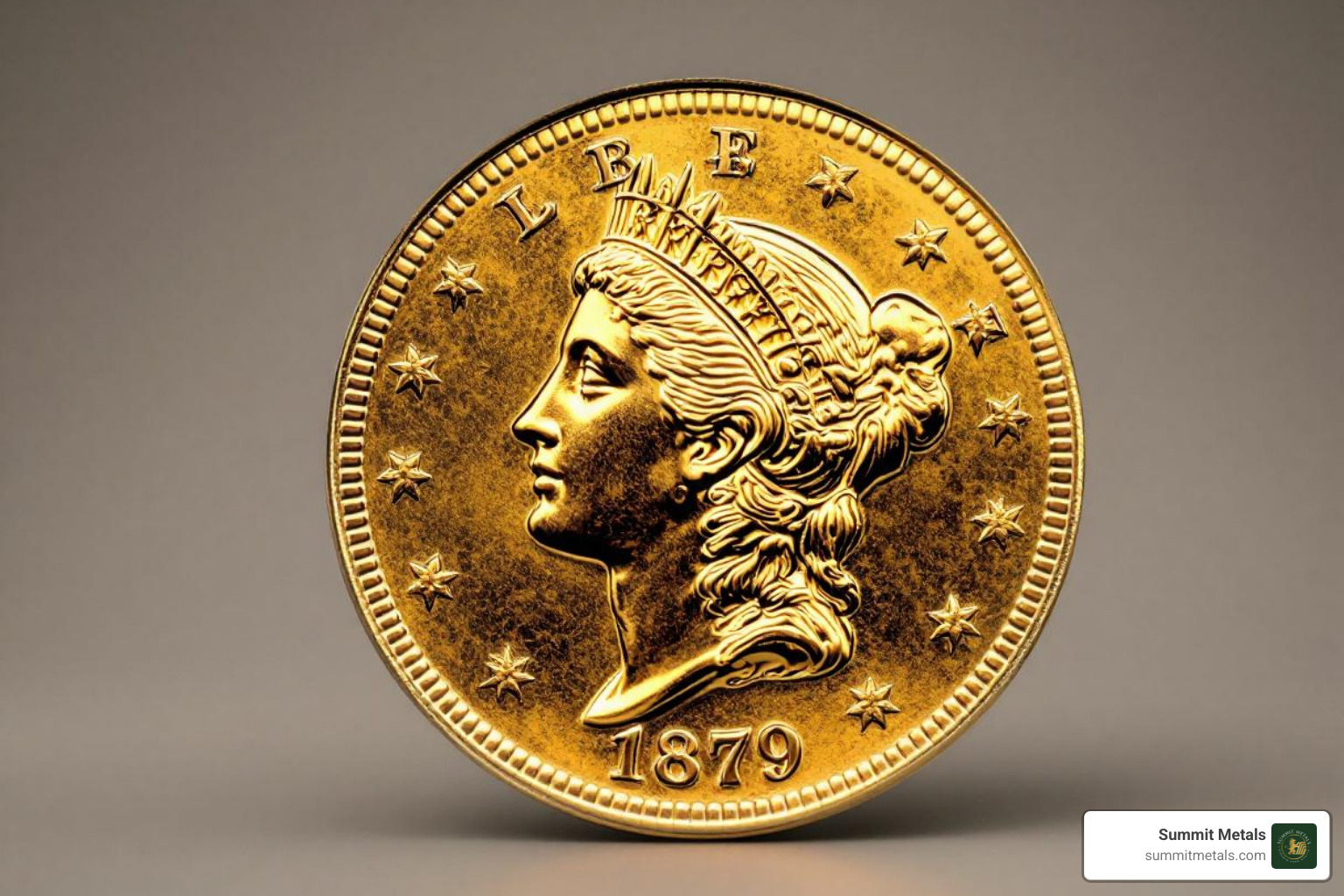
The 1879 gold eagle represents a fascinating chapter in American numismatic history, minted during the post-Civil War recovery when the nation returned to the gold standard. These coins were struck in four different mints—Philadelphia, San Francisco, Carson City, and New Orleans—with values ranging dramatically based on their origin and condition.
Quick Value Overview:
| Mint Mark | Mintage | Typical Value (VF-20) | High-Grade Value |
|---|---|---|---|
| Philadelphia (no mark) | 384,770 | $1,329 | $4,835+ (MS-64) |
| San Francisco (S) | 224,000 | $1,329 | $80,750+ (MS-64) |
| Carson City (CC) | 1,762 | $15,000 | Extremely rare |
| New Orleans (O) | 1,500 | $10,000 | $114,000+ (top grades) |
The Carson City and New Orleans issues stand out as genuine rarities—the 1879-CC produced only 1,762 coins, while the 1879-O minted just 1,500. These low mintages, combined with heavy melting after 1933's gold recall, make surviving examples highly sought after by collectors and investors alike.
Key Factors Affecting Value:
- Mint mark location dramatically impacts rarity
- Condition grade (coins in MS-64 or higher command substantial premiums)
- Survival rate (most were melted; only 1,550 examples across all grades survive)
- Gold content provides a baseline melt value of approximately $1,118
I'm Eric Roach, and during my decade advising Fortune 500 companies on hedging strategies in New York, I learned how tangible assets like the 1879 gold eagle serve as portfolio anchors during economic volatility. Today I help everyday investors apply those same institutional principles to protect wealth through historic precious metals.
Whether you're drawn to the 1879 gold eagle for its historical significance, numismatic potential, or simply as a hedge against inflation, understanding its specifications and market dynamics is essential. The coin's 90% gold composition (0.48375 troy ounces), combined with its place in the Liberty Head series (1838-1907), makes it both a collectible treasure and a store of intrinsic value.
1879 gold eagle terms to know:
- 1836 quarter eagle
- 1849 coronet head gold $20 double eagle unique smithsonian collection
- $5 gold liberty head
The Many Faces of the 1879 Gold Coinage: Denominations and Mints
The year 1879 was a busy one for the United States Mint, producing a variety of gold denominations, each carrying its own unique story and level of rarity. From the smallest Quarter Eagle to the imposing Double Eagle, these coins reflect the economic vibrancy of the Gilded Age. Understanding the different types and their mint of origin is crucial for any collector or investor interested in the 1879 gold eagle.
Let's break down the different gold coins minted in 1879:
- $2.50 Liberty Head Quarter Eagle: Designed by Christian Gobrecht, these smaller gold coins were struck at both the Philadelphia (no mint mark) and San Francisco ('S') mints. While over 130,000 were produced, their smaller size often led to more circulation wear. A Philadelphia mint Quarter Eagle in Extremely Fine (EF) condition might fetch around $365, while an Uncirculated (Unc) example could be $375. The San Francisco mint version, slightly rarer in top grades, sees Uncirculated examples valued around $550.
- $5 Liberty Head Half Eagle: Also featuring the Coronet Head design by Christian Gobrecht, the 1879 Half Eagle was predominantly minted in San Francisco ('S'), with a mintage of 426,200. These coins have a diameter of 21.6 mm and weigh 8.36 grams. While a typical Half Eagle in average condition might be valued at $939, an uncirculated (MS+) coin can range from $1,074 to $2,176+. Their melt value stands at approximately $777.73.
-
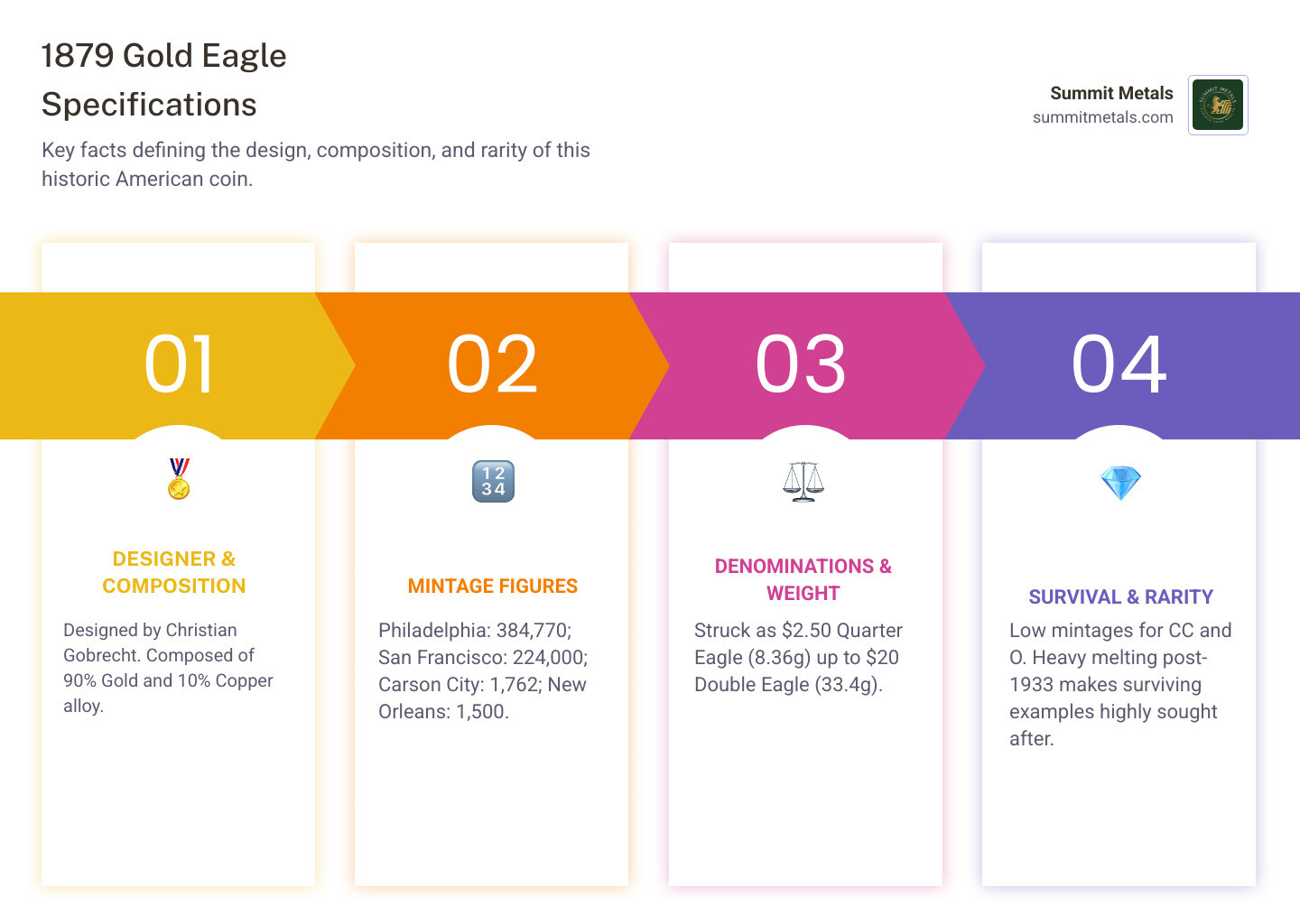
$10 Liberty Head Eagle: The main subject of our discussion, the 1879 gold eagle in its $10 denomination, was also designed by Christian Gobrecht. This coin has a diameter of 26.80 millimeters and contains 0.48375 troy ounces of gold. The overall mintage for the year was 612,032 pieces, distributed across four mints:
- Philadelphia (no mint mark): With 384,770 coins minted, this is the most common variety. A Very Fine (VF-20) example is typically valued around $1,329.
- San Francisco ('S'): Producing 224,000 coins, these are also relatively common. A VF-20 coin similarly holds a value around $1,329.
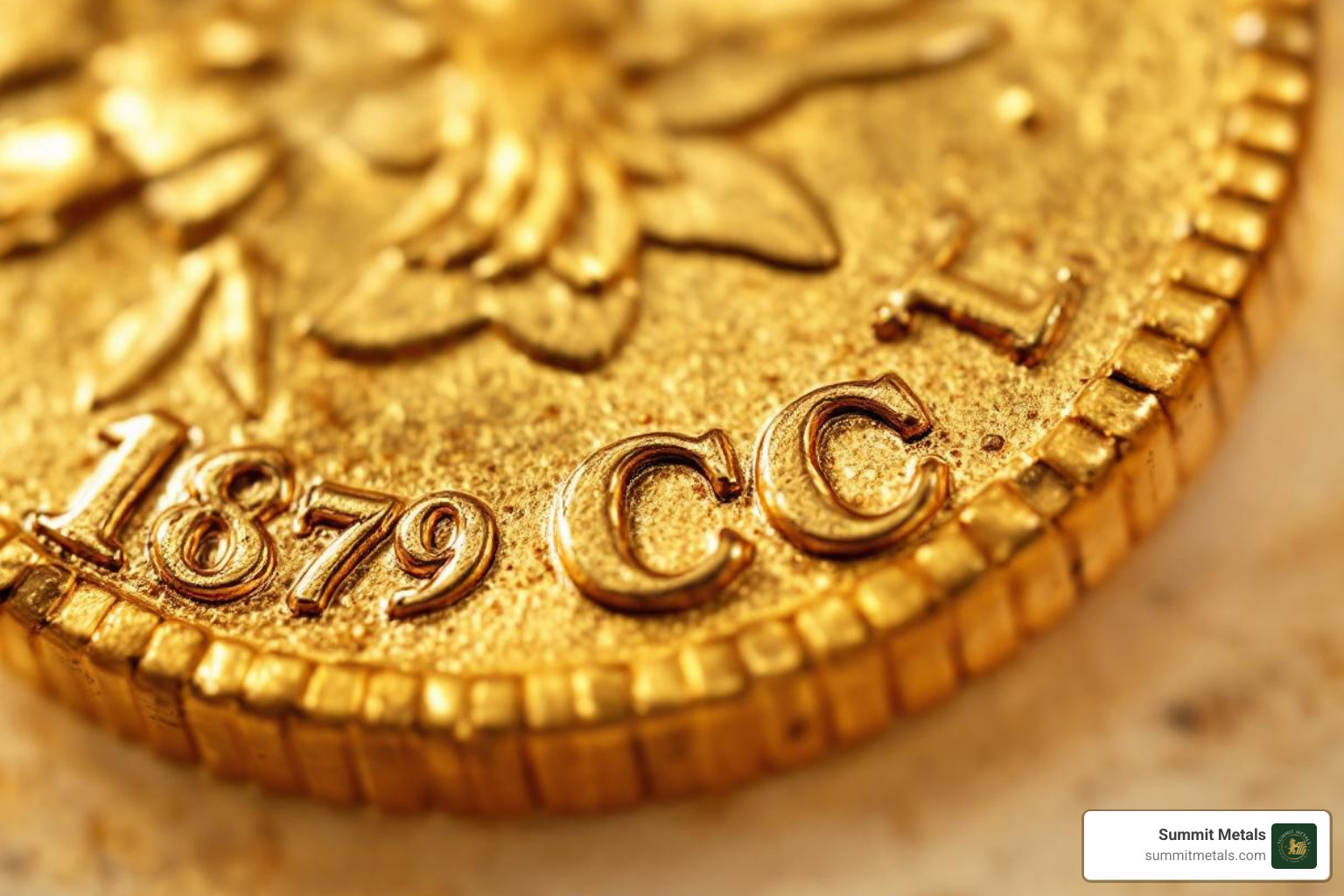
- Carson City ('CC'): This is where things get exciting! Only 1,762 1879 gold eagle coins were struck at the Carson City Mint. This extremely low mintage makes the 1879-CC a significant rarity, with a VF-20 example commanding prices around $15,000.
- New Orleans ('O'): Another key rarity, the New Orleans Mint produced an even smaller quantity, just 1,500 coins. A VF-20 1879-O can be valued around $10,000.
- Proof Issues: Proof versions of the 1879 $10 Eagle, struck in limited numbers for collectors, are exceptionally rare and valuable, with an estimated value of $83,000.
-
$20 Liberty Head Double Eagle: The largest gold denomination, the 1879 Double Eagle, was designed by James B. Longacre. It has a diameter of 34 mm, weighs 33.4 grams, and contains 0.9675 troy ounces of gold.
- San Francisco ('S'): The 1879-S $20 Liberty Gold Double Eagle had a substantial mintage of 1,223,800.
- New Orleans ('O'): The 1879-O Liberty Head Double Eagle is a particularly fascinating and rare coin. Only 2,325 were minted, primarily due to the reopening of the New Orleans Mint after the Civil War. Its production is believed by some to have been a symbolic gesture to mark the resumption of coinage. An astonishingly low 100-120 examples are estimated to survive in all conditions, making it a leading rarity in the Southern gold series. An example from the Fairmont Collection Hendricks Set realized an impressive $114,000 at auction.
The low mintages of the Carson City and New Orleans issues for both the $10 Eagle and $20 Double Eagle make them true "key date" coins. These were often produced in smaller quantities due to specific regional demands or the limited capacity of branch mints. As we explore in our guide on Discovering the Legacy of Liberty Head Gold Coins, the story behind these mints adds layers of intrigue and value to these already precious pieces.
Here's a comparison of the different 1879 gold denominations:
| Denomination | Designer | Weight (grams) | Gold Content (troy oz) | Diameter (mm) | General Value Range (VF-20) |
|---|---|---|---|---|---|
| $2.50 Eagle | Christian Gobrecht | 4.18 | 0.12094 | 18 | $365 - $550 |
| $5 Half Eagle | Christian Gobrecht | 8.36 | 0.24187 | 21.6 | $939 - $2,176 |
| $10 Eagle | Christian Gobrecht | 16.72 | 0.48375 | 26.8 | $1,329 - $15,000 |
| $20 Double Eagle | James B. Longacre | 33.43 | 0.9675 | 34 | $3,375 - $114,000+ |
Design, Specifications, and Historical Significance
The 1879 gold eagle, regardless of its denomination, is a testament to 19th-century American artistry and economic policy. Its design, metal composition, and historical context are all integral to its allure and value.
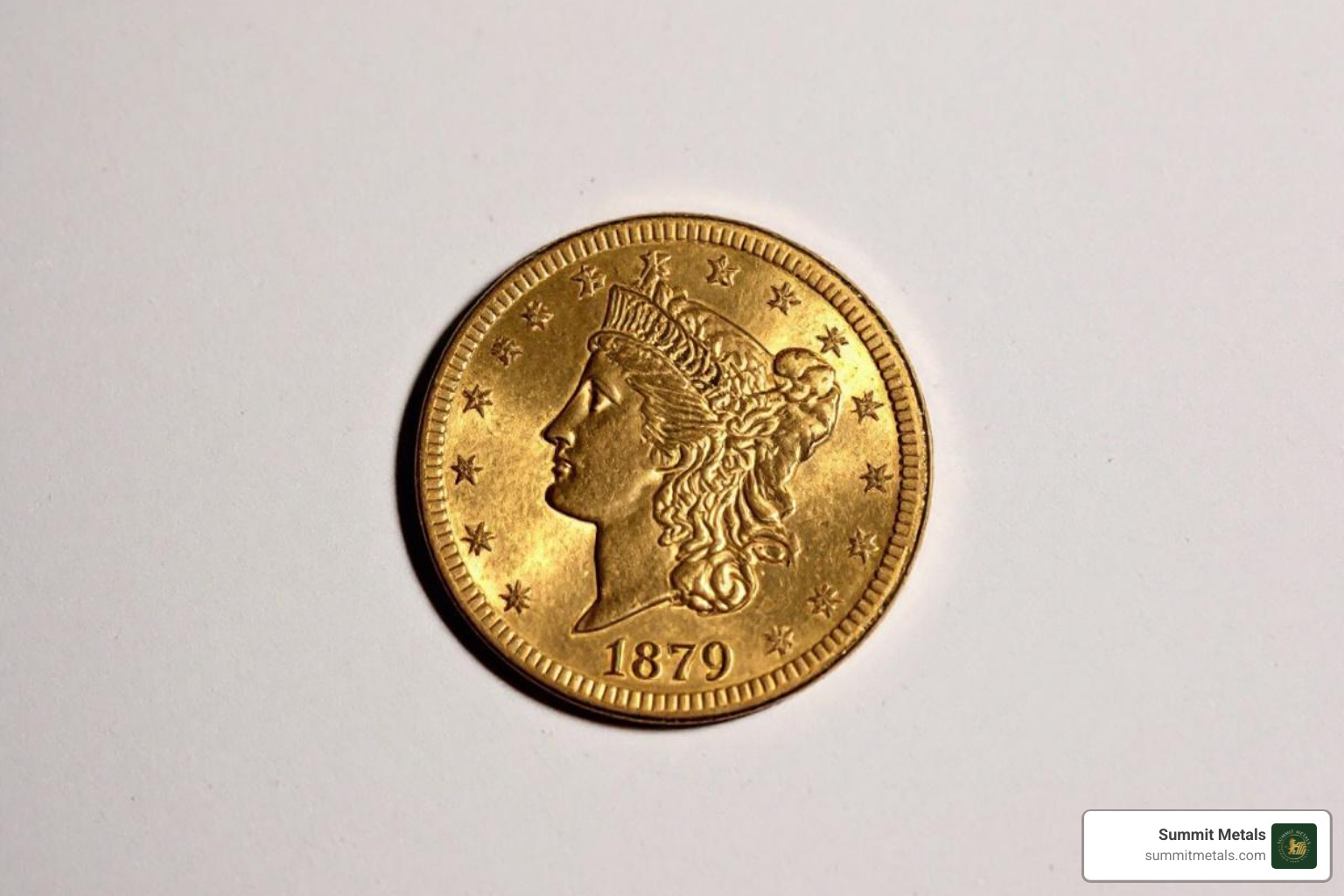
The central figure on the obverse (front) of the Liberty Head series, including the 1879 issues, is Lady Liberty. She is depicted facing left, her hair tied back, adorned with a coronet inscribed with the word "LIBERTY." This iconic "Coronet Head" design, created by Christian Gobrecht for the $2.50, $5, and $10 Eagles, and James B. Longacre for the $20 Double Eagle, evokes classical ideals of freedom and prosperity. Thirteen stars encircle Liberty's portrait, representing the original thirteen colonies, while the year "1879" is prominently displayed below.
The reverse (back) of these coins features a majestic heraldic eagle, often referred to as the "Heraldic Eagle" or "Eagle with Shield." The eagle clutches an olive branch (symbolizing peace) and arrows (representing war readiness) in its talons. Above its head, a halo of stars often appears, and a banner or scroll bearing the motto "IN GOD WE TRUST" is typically present. This motto was added to U.S. coinage starting in 1866, reflecting the nation's spiritual sentiment during and after the Civil War. Encircling the eagle are the inscriptions "UNITED STATES OF AMERICA" and the coin's denomination, which for the $10 Eagle reads "TEN D." or "TEN DOLLARS" and for the Double Eagle "TWENTY DOLLARS."
From a metallurgical standpoint, the 1879 gold eagle coins adhere to the standard of 90% gold and 10% copper. This alloy, known as "coin gold," was chosen for its durability, making the coins more resistant to wear during circulation than pure gold would have been. The copper content also gives the coins a distinctive orange-yellow hue.
The historical backdrop of 1879 is equally compelling. The nation was still recovering from the economic turmoil of the Civil War. A significant event in this period was the resumption of specie payments in 1879, meaning that paper money could once again be exchanged for gold or silver coins at face value. This move solidified the nation's commitment to the gold standard, providing stability to the economy. The reopening of the New Orleans Mint in 1879, after its closure during the war, further underscored this economic resurgence, even if its mintage of Double Eagles was largely symbolic.
These coins are more than just currency; they are tangible artifacts of a pivotal era. They remind us of a time when gold was the bedrock of our financial system, a concept we explore further in our article, A Brief History of Gold as Currency and Store of Value.
Determining the Value of Your 1879 Gold Eagle
Understanding the value of your 1879 gold eagle requires looking beyond its intrinsic melt value. While the gold content provides a baseline, the true numismatic worth is a complex interplay of rarity, condition, and market demand. Here at Summit Metals, we believe in transparent pricing and helping you understand what makes these historical assets so valuable.
A coin's overall value is a combination of its precious metal content (melt value) and its numismatic premium. This premium is driven by three critical factors: the mint mark, its condition or grade, and its estimated survival rate.
The Impact of Mint Marks on the 1879 Gold Eagle's Worth
As we've seen, the mint mark on your 1879 gold eagle is arguably the most significant determinant of its rarity and, consequently, its value. The U.S. Mint operated several branch mints in 1879, each identified by a small letter on the coin's reverse, usually below the eagle.
- Philadelphia (no mint mark): The main U.S. Mint facility, Philadelphia produced the largest quantity of $10 Eagles in 1879, with a mintage of 384,770. While still a historic gold coin, these are generally the most accessible and least expensive of the 1879 issues.
- San Francisco ('S'): The San Francisco Mint struck 224,000 $10 Eagles in 1879. These coins served the booming economy of the American West and are also relatively common compared to their branch mint counterparts. For example, an 1879-S $10 Eagle in MS-64 condition has an estimated value of $80,750, showcasing the significant jump in value for higher grades, even for higher mintage coins.
- Carson City ('CC'): A true rarity, the Carson City Mint produced a mere 1,762 1879 gold eagle ($10) coins. The "CC" mint mark is highly sought after by collectors due to this extremely low mintage and the romantic history of the Old West mint. A VF-20 1879-CC $10 Eagle can command around $15,000.
- New Orleans ('O'): Equally rare, the New Orleans Mint struck only 1,500 1879 gold eagle ($10) coins. The "O" mint mark signifies a coin steeped in post-Civil War recovery and limited production. A VF-20 1879-O $10 Eagle is valued at approximately $10,000.
The stark difference in mintage numbers between Philadelphia/San Francisco and Carson City/New Orleans creates a dramatic "rarity factor." Coins from the lower-mintage branch mints are often considered "key dates" or "semi-key dates" within the Liberty Head series, making them prime candidates for investment potential beyond their intrinsic gold value. This distinction is critical for any collector or investor, as we discuss further in our article, Is Your Liberty Head Gold Coin a Hidden Fortune? A Deep Dive into Key Dates.
Grading Your 1879 Gold Eagle: From Circulated to Mint State
The condition, or "grade," of your 1879 gold eagle plays a monumental role in its market value. Coins are graded on a 70-point scale, where 1 represents a barely identifiable coin and 70 signifies a perfect, flawless specimen.
Common grades you might encounter include:
- Good (G-4): These coins show significant wear, with major design elements flattened. All lettering and major features are visible, but details are faint. An 1879 $10 Eagle in this condition might have a market value around its melt value, which is approximately $1,118 (at the time of this publication).
- Very Fine (VF-20): Coins in this grade show moderate wear on the high points of the design. All major details are clear, but some of the finer details, like hair strands on Liberty, may be worn. A Philadelphia or San Francisco 1879 gold eagle in VF-20 might be valued around $1,329.
-
Uncirculated (MS): This category encompasses coins that show no signs of wear from circulation. They retain their original mint luster. Uncirculated coins are further subdivided into Mint State (MS) grades from MS-60 to MS-70.
- MS-64: An uncirculated coin with minor imperfections, such as small contact marks or slight loss of luster. An 1879 $10 Eagle from Philadelphia in MS-64 could be valued around $4,835.72. For the rarer 1879-S $10 Eagle, an MS-64 example has been estimated at $80,750, highlighting the combined impact of mint mark and grade.
- MS-65: A gem uncirculated coin with strong luster and very few, if any, distracting marks. These are highly prized. An 1879 $10 Eagle from Philadelphia in MS-65 might reach $5,319, while an MS-66 could jump to $214,031.11!
- MS-65 or higher: Coins in this echelon are exceptionally rare. For the 1879 $10 Eagle, only about 4 are estimated to survive in MS-65 or better condition.
Professional grading services like PCGS (Professional Coin Grading Service) and NGC (Numismatic Guaranty Company) authenticate and grade coins, encapsulating them in sealed holders to preserve their condition and guarantee their grade. Their survival estimates provide crucial insights into the true rarity of coins in various conditions. For instance, PCGS estimates around 300 1879 gold eagle coins survive in MS-64+ condition, while MS-65 or higher examples are considered extremely rare.
The difference in value between a circulated coin and a high-grade uncirculated specimen can be astronomical. We always recommend having your valuable historic coins professionally graded.
Notable Sales and Auction Records
The market for high-grade and rare 1879 gold eagle coins can be incredibly dynamic, with auction results often setting new benchmarks for value. These sales underscore the significant numismatic premium that rare, well-preserved examples command.
One of the most remarkable sales is that of the 1879-O Liberty Head Double Eagle. Given its extremely low mintage and estimated survival rate, this coin is a numismatic superstar. An example from the Fairmont Collection Hendricks Set, sold by Stack's Bowers Galleries, realized an astounding $114,000. This sale highlights the immense value placed on coins that combine rarity, historical significance, and excellent condition. You can explore more about these significant sales by viewing the 1879-O Liberty Head Double Eagle Auction Results.
Another impressive record comes from the $10 Liberty Head Eagle series. An 1879 $10 Gold Liberty Head Eagle graded MS66 by PCGS sold for $66,700 in August 2007. More recently, an MS64+ PCGS graded example fetched $8,225 in August 2013, while an MS64 PCGS coin sold for $3,600 in April 2020. These figures demonstrate that while the top-tier prices are reserved for the absolute finest examples, even high-end uncirculated coins can command substantial premiums.
These auction results serve as critical market value indicators for collectors and investors. They showcase the strong demand for these historic gold pieces and illustrate how rarity, combined with impeccable condition, can lift a coin's value far beyond its intrinsic gold content.
Investing in Historic Gold: A Tangible Asset
Investing in historic gold coins like the 1879 gold eagle offers a unique blend of benefits that go beyond simply holding modern bullion. These coins combine the intrinsic value of precious metal with a numismatic premium derived from their historical significance, rarity, and aesthetic appeal.
When considering gold investments, we often compare modern gold bars or rounds with historic gold coins. While gold bars offer a straightforward way to invest in the metal's spot price, historic coins provide several distinct advantages:
- Numismatic Premium: Unlike generic bullion, historic coins have a "numismatic premium" that can appreciate independently of the gold spot price. This premium is based on factors like mintage figures, survival rates, historical importance, and collector demand. This means your 1879 gold eagle has two avenues for value growth: the rising price of gold and increasing demand from collectors.
- Legal Tender Status: As U.S. coinage, these pieces carry a face value (e.g., $10 or $20), which is backed by the U.S. government. While their melt value far exceeds this, the legal tender status can offer a layer of fraud protection and recognition that generic gold bars may not have. It's a small detail, but it speaks to the authenticity and official nature of the coin.
- Historical Significance: Owning an 1879 gold eagle is owning a piece of American history. It connects you to the Gilded Age, the gold standard, and the economic narratives of the late 19th century. This historical aspect adds an intangible value that many investors and collectors cherish.
- Portfolio Diversification: Gold, in any form, is a classic hedge against inflation and economic uncertainty. Historic gold coins further diversify a portfolio by adding an asset class with both commodity and collectible characteristics. They can perform differently than stocks, bonds, or even modern bullion, offering a unique layer of stability.
At Summit Metals, we understand the appeal of these tangible assets. We believe in empowering our clients with strategies for long-term wealth protection. One such powerful strategy is dollar-cost averaging, where you invest a fixed amount regularly, regardless of market fluctuations. This approach, often used in retirement accounts, can be applied to precious metals through our Autoinvest program. By consistently adding historic gold like the 1879 gold eagle to your portfolio, you can smooth out market volatility and build your wealth over time, much like investing in a 401k. For more insights, explore The Power of Dollar Cost Averaging in Gold and Silver Investments.
For a deeper dive into the advantages of gold coins over bars, we recommend our comprehensive guide: How to Compare Gold Bars vs. Gold Coins: 5 Factors to Consider.
Frequently Asked Questions about the 1879 Gold Eagle
We often receive questions about these fascinating historical coins. Here are some of the most common inquiries about the 1879 gold eagle:
What is the most valuable 1879 gold eagle?
Without a doubt, the 1879-O Liberty Head Double Eagle stands out as the most valuable of the 1879 gold eagles. With a mintage of only 2,325 coins and an estimated 100-120 survivors, its rarity is exceptionally high. An example from the Fairmont Collection Hendricks Set achieved an auction record of $114,000, solidifying its status as a top-tier numismatic treasure.
Other major contenders for high value include the low-mintage $10 Eagles from Carson City (1879-CC, 1,762 minted) and New Orleans (1879-O, 1,500 minted). Any proof or exceptionally high-grade Mint State examples (MS-65 or higher) from any mint are also extremely rare and command significant premiums, often reaching tens of thousands of dollars, as seen with the 1879 $10 Eagle MS66 selling for $66,700.
How can I tell if my 1879 gold coin is real?
Authenticating a historic gold coin like the 1879 gold eagle is paramount to protecting your investment. The most reliable method is professional grading by reputable services such as PCGS or NGC. These organizations have expert numismatists who can verify authenticity, condition, and assign a grade, which is then sealed in a tamper-evident holder.
For initial at-home checks, you can compare your coin's weight, diameter, and design details against official specifications (e.g., a $10 Eagle should weigh 16.72 grams and have a diameter of 26.80 mm, while a $20 Double Eagle should weigh 33.43 grams and have a diameter of 34 mm). You can also perform non-destructive tests like the "ping test" or use a strong magnet (gold is not magnetic). However, these are not foolproof. For a comprehensive guide on identifying genuine gold, please refer to our article How to Tell If Gold Is Real. When dealing with valuable historic coins, always seek professional authentication.
Is an 1879 gold eagle a good investment?
Yes, an 1879 gold eagle can be an excellent investment for several reasons. Primarily, it holds significant intrinsic value due to its high gold content (90% pure gold). This provides a solid floor for its price, tying it to the global gold market. Beyond its metal value, it possesses considerable potential for numismatic appreciation. Its rarity, historical significance, and condition contribute to a premium that can grow over time, independent of gold's spot price.
As a tangible asset, it offers portfolio diversification, acting as a hedge against economic instability, inflation, and currency devaluation. Unlike purely speculative investments, an 1879 gold eagle is a physical asset with a proven track record of enduring value. For a deeper discussion on the benefits of gold as an investment, we invite you to read Is Gold a Good Investment.
Conclusion: Secure Your Piece of American History
The 1879 gold eagle is far more than just a coin; it's a tangible link to a pivotal moment in American economic history, reflecting the nation's journey through the Gilded Age and its commitment to the gold standard. Its value is a fascinating blend of precious metal content, profound historical significance, and compelling numismatic rarity. Each mint mark, from the busy Philadelphia to the rare Carson City and New Orleans issues, tells a unique story, and every grade, from a well-worn VF-20 to a pristine MS-65, dictates its market destiny.
For collectors, these coins offer a window into the past, a chance to hold a piece of history in their hands. For investors, they represent a strategic asset, combining the enduring value of gold with the potential for numismatic appreciation. We, at Summit Metals, understand the allure and importance of these historic gold pieces. Whether you're a seasoned numismatist or just beginning to explore precious metals, acquiring authenticated historic gold requires trust and expertise.
We pride ourselves on offering transparent pricing and unparalleled guidance, ensuring you can confidently add these timeless assets to your collection or investment portfolio. Just as we advocate for consistent, disciplined investing through our Autoinvest program for modern bullion, we believe in the enduring value that historic coins like the 1879 gold eagle can bring to your financial future. Find more about the broader world of American gold coinage in our guide, Everything You Need to Know About American Eagle Coins.


